

Blog
Heating a Rhode Island home in winter 2026–27: oil hits a record, gas dips, and what each fuel really costs
By Green Robot Research · October 27, 2026
The short version: Rhode Island heating oil averaged $6.380 a gallon in the week of October 19, 2026, up from $3.610 a year earlier (+77%). That is the highest weekly price in the U.S. Energy Information Administration's Rhode Island series, which goes back to 1990, and the highest of any New England state that week (EIA, weekly heating oil and propane prices, Rhode Island). Natural gas customers face the opposite: Rhode Island Energy has proposed a 2.1% cut for a typical heating customer starting November 1, still awaiting the Public Utilities Commission's decision (RI PUC, Docket 26-23-NG). About one in four Rhode Island homes heats with oil, and in 15 of the 39 cities and towns it is more than half.
Below: each fuel's price, what it means for a winter bill, who is most exposed, and the programs that can help.
1. Heating oil: the highest price on record
EIA surveys residential heating oil and propane prices every week from October through March. Its Rhode Island readings for the first three weeks of this season were $6.126, $6.304 and $6.380 per gallon, excluding taxes (EIA, Rhode Island weekly prices). The previous high in the series was $5.884 in late October 2022. Prices are in nominal dollars, not adjusted for inflation.
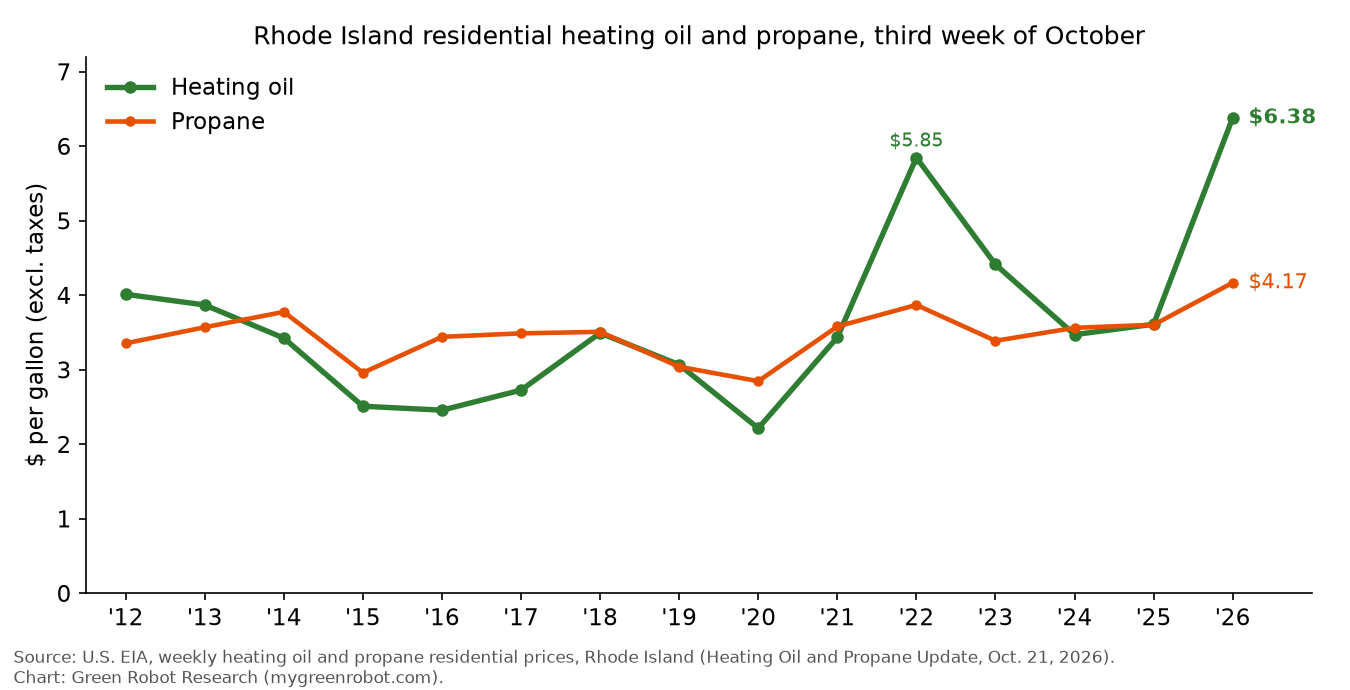
Source: U.S. EIA, Heating Oil and Propane Update, Rhode Island weekly residential series (No. 2 heating oil and propane), release of October 21, 2026.
The jump began last winter. Oil sat between about $3.61 and $3.93 from October to January, then spiked in March 2026 to $5.813 on March 23 before the survey paused. When it resumed in October, prices were higher still.
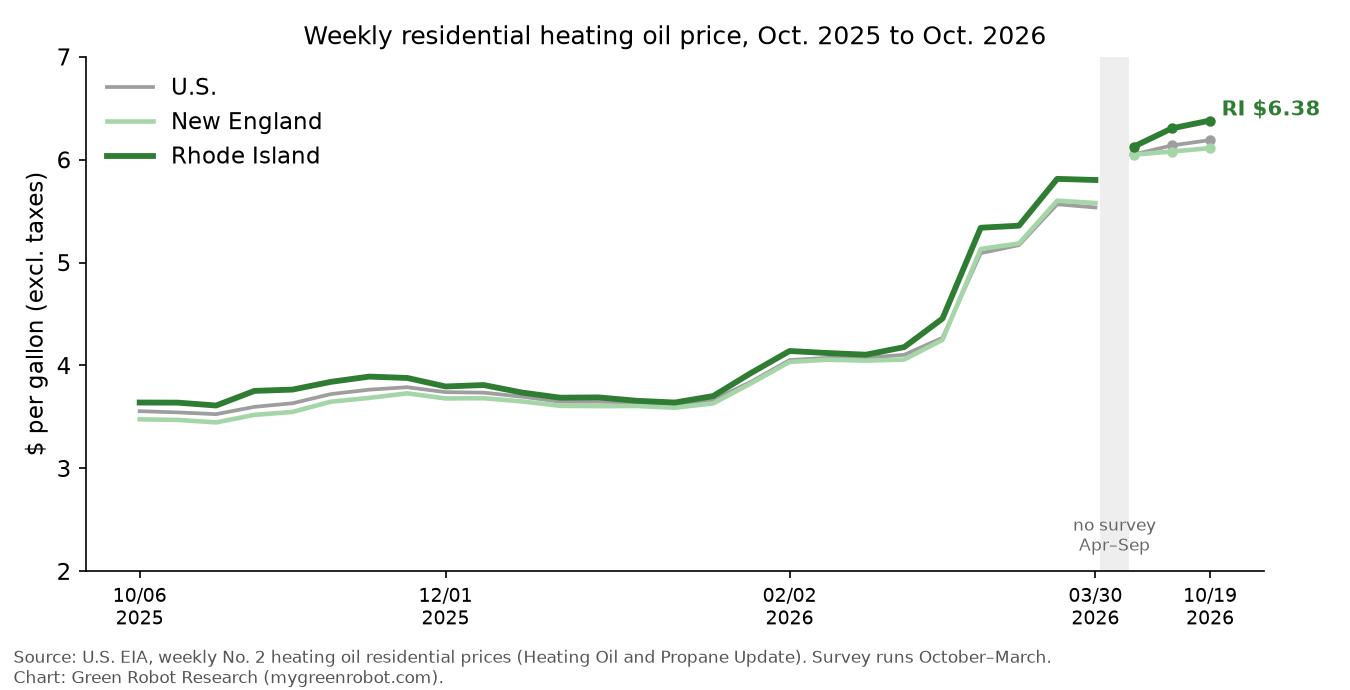
Source: U.S. EIA, weekly No. 2 heating oil residential prices for Rhode Island, New England (PADD 1A) and the U.S.
EIA's explanation: global production of distillate fuel (heating oil and diesel) has fallen with reduced refining activity, so U.S. distillate stocks are low going into winter (EIA, Winter Fuels Outlook 2026–27, Oct. 6, 2026).
Heating oil and propane, week of October 19, 2026 ($ per gallon, excluding taxes)
| Area | Heating oil | Propane |
|---|---|---|
| Rhode Island | $6.380 | $4.167 |
| Connecticut | $6.154 | $4.226 |
| Massachusetts | $6.115 | $3.659 |
| Vermont | $6.097 | $3.881 |
| New Hampshire | $6.033 | $3.843 |
| Maine | $6.026 | $3.709 |
| New England average | $6.112 | $3.872 |
| U.S. average | $6.190 | $2.689 |
| Rhode Island, one year earlier (Oct. 20, 2025) | $3.610 | $3.603 |
Source: EIA, weekly heating oil prices by state and weekly propane prices by state.
What it means for a bill. EIA does not publish a Rhode Island oil bill forecast. As a yardstick: every 100 gallons now costs about $638, versus $361 a year ago. EIA's national forecast assumes the average oil-heated home uses 402 gallons this winter (EIA, Winter Fuels Outlook); at Rhode Island's current price that would be about $2,565, compared with about $1,451 at last October's price. (our arithmetic, assuming a constant price). For the U.S. as a whole, EIA expects oil-heated households to spend $2,115, up 21%, at an average $5.26 a gallon.
2. Propane: up, but far less than oil
Rhode Island propane averaged $4.167 a gallon on October 19, up 16% from $3.603 a year earlier, and second only to Connecticut in New England. It is not a record: the series peaked at $4.66 in March 2014 (EIA, Rhode Island weekly prices).
EIA forecasts a $1,687 winter bill for Northeast propane homes (515 gallons at $3.28). At Rhode Island's current price, the same 515 gallons would cost about $2,146 (our arithmetic).
3. Natural gas: a small proposed cut on Nov. 1
Utility gas is the main heating fuel in 53.4% of Rhode Island homes (ACS 2024, table B25040). Rhode Island Energy's gas supply charge (the Gas Cost Recovery, or GCR) resets every November 1.
In its revised filing of September 23, 2026, Rhode Island Energy says a typical residential heating customer using 845 therms a year would see the annual bill fall $42.09, from $1,976.52 to $1,934.43 (−2.1%). Lower gas supply costs account for $36.00 of that (RI Energy revised GCR and DAC schedules, Sept. 23, 2026). The residential gas cost factor would drop from $0.6342 to $0.5916 per therm. As of the docket page's October 23 update, the PUC had not posted a decision (Docket 26-23-NG).
Proposed annual gas bill, residential heating customers (effective Nov. 1, 2026 if approved)
| Annual use | Proposed annual bill | Roughly per month |
|---|---|---|
| 512 therms | $1,248.25 | $104 |
| 620 therms | $1,471.16 | $123 |
| 845 therms (typical) | $1,934.43 | $161 |
| 1,060 therms | $2,378.81 | $198 |
| 845 therms, low-income discount rate | $1,434.56 | $120 |
Source: RI Energy revised schedules, Sept. 23, 2026, typical bill tables. Monthly column is the annual bill divided by 12; real bills are far higher in winter.
Most of that use happens in the cold months. Rhode Island Energy's own forecast puts 69.5% of annual residential heating throughput in November through March (RI Energy GCR filing, Book 1). Applying that share to the 845-therm customer, we estimate a November–March gas bill of about $1,290, or roughly $260 a month. This is our estimate, not a company figure (see "How we calculated").
Rhode Island gas is still expensive by national standards. EIA's annual residential price for Rhode Island was $21.66 per thousand cubic feet in 2024, against $14.50 nationally; it has risen about 52% since 2015 (EIA, residential natural gas price by state).
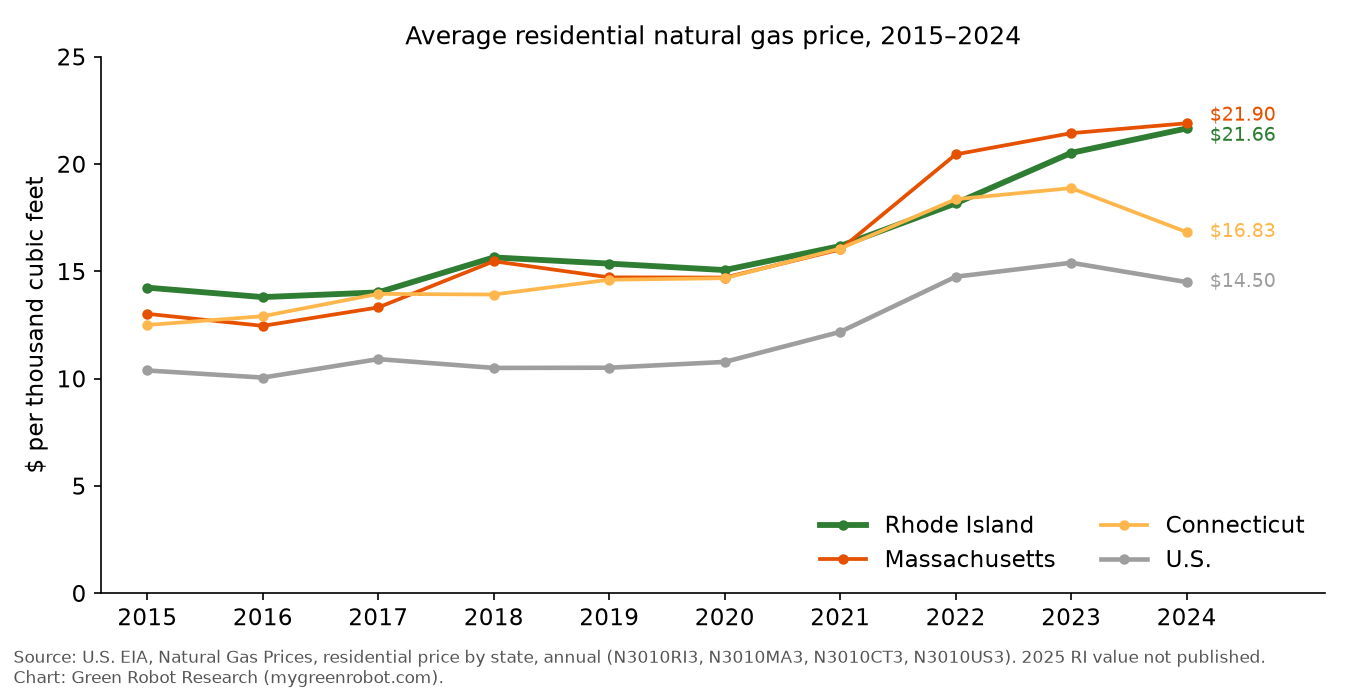
Source: U.S. EIA, Natural Gas Prices, annual residential price by state. EIA had not published a 2025 annual value for Rhode Island when we pulled the data.
Watch out for mid-winter changes. After a cold snap from January 23 to February 9, 2026, Rhode Island Energy filed for an interim gas cost increase of $0.3313 per therm on March 31, 2026, then withdrew it on May 28 (RI PUC, Docket 25-22-NG). A cold spell could prompt another.
4. Electric heat and heat pumps

About 14.2% of Rhode Island homes heat mainly with electricity (ACS 2024, B25040) (baseboard or heat pumps; the Census doesn't split them).
On October 1, Rhode Island Energy's residential Last Resort Service supply rate rose to 17.029¢ per kWh for October through March (RI Energy, LRS rates table, Oct. 2026–Mar. 2027). Adding the per-kWh delivery charges on the standard A-16 rate (distribution 6.853¢, renewable distribution 1.947¢, transmission 5.275¢, energy efficiency 1.199¢) (RI Energy, residential service rates) and the 4% gross earnings tax, each extra kWh this winter costs about 33.6¢.
At that price, electric baseboard is the most expensive way to heat (about $98 per million Btu, section 5). A heat pump delivers two to three units of heat per unit of electricity, cutting that to about $33–39.
EIA forecasts that Northeast homes that heat with electricity will spend $1,637 this winter (−3%), using 6,252 kWh at an average 26.19¢ (EIA, Winter Fuels Outlook). At Rhode Island's 33.6¢, 6,252 kWh would be about $2,100 (our arithmetic).
No heat pump rate yet. The Conservation Law Foundation proposed a lower heat pump delivery rate in Rhode Island Energy's rate case; the settlement replaced it with a future "monetary benefit" proposal and a cost study, subject to PUC approval (Heat Pump Settlement, Docket 25-45-GE). We found no separate heat pump rate in effect for this winter.
5. Same heat, different fuel: the cost of a unit of heat
Gallons, therms and kWh aren't comparable on their own. We converted each price to the cost of one million Btu (MMBtu) of heat actually delivered into the home, using EIA's heat contents (EIA, British thermal units) and typical efficiencies that we assumed (listed in the chart).
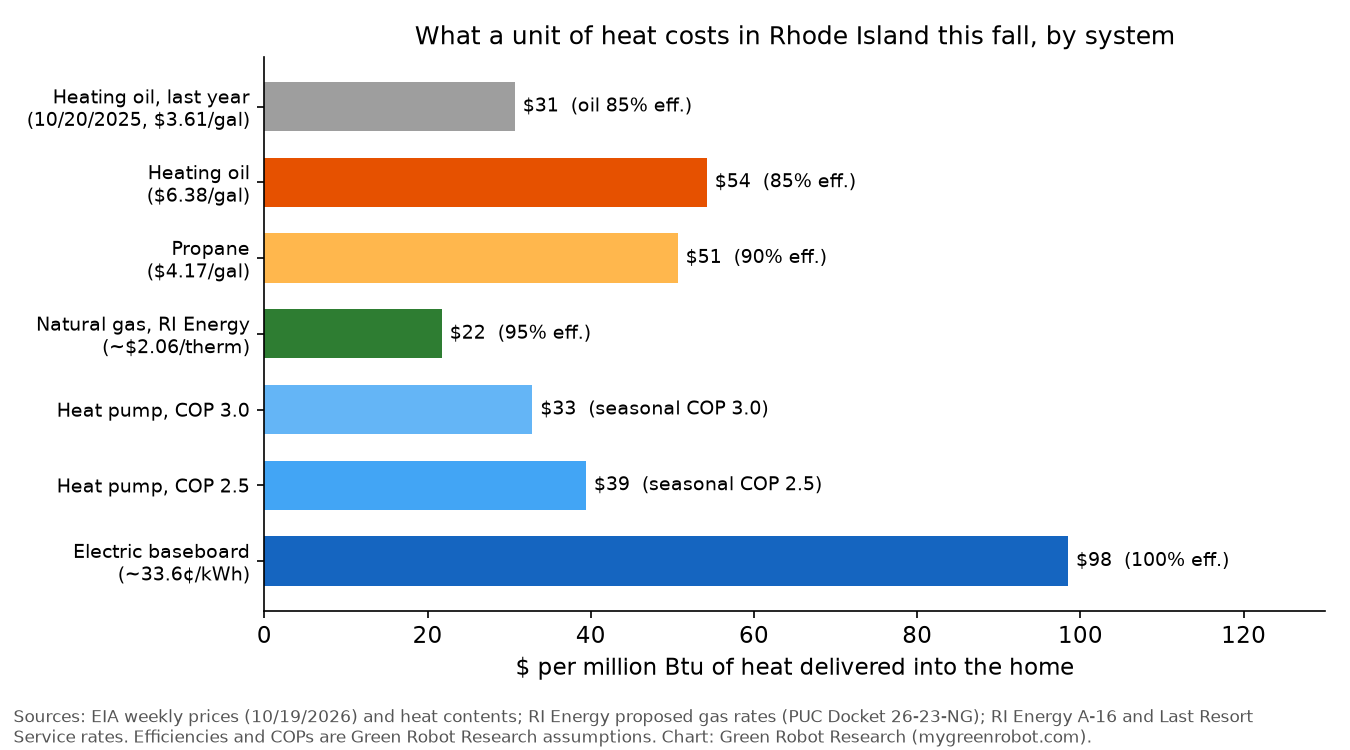
Sources: EIA weekly prices (Oct. 19, 2026) and heat contents; RI Energy proposed gas rates; RI Energy A-16 and LRS rates. Efficiencies and heat pump COPs are Green Robot Research assumptions.
To make this concrete, we took the heat in the typical gas customer's 845 therms (about 80 MMBtu delivered at 95% efficiency) and priced the same heat with each fuel:
Illustrative annual cost for the same amount of heat (about 80 MMBtu delivered)
| System | Fuel needed | Cost at current prices |
|---|---|---|
| Natural gas (RI Energy, proposed Nov. 1 rates, incl. fixed charges) | 845 therms | $1,934 |
| Cold-climate heat pump, seasonal COP 3.0 | ~7,840 kWh | ~$2,635 |
| Cold-climate heat pump, seasonal COP 2.5 | ~9,410 kWh | ~$3,160 |
| Propane furnace/boiler, 90% | ~975 gallons | ~$4,064 |
| Oil furnace/boiler, 85% | ~682 gallons | ~$4,350 |
| Oil, same gallons at last October's price | ~682 gallons | ~$2,462 |
| Electric baseboard | ~23,530 kWh | ~$7,904 |
Our calculation. The 845 therms include some non-heating gas use, so treat this as a comparison of fuels, not a bill forecast. Except for gas, the costs leave out fixed charges and equipment costs.
Two takeaways:
- Oil versus heat pumps flipped this year. At $3.61 oil, an 85%-efficient oil system ($31/MMBtu) was cheaper to run than a heat pump at today's electric rate. At $6.38, it costs more than a heat pump at any realistic efficiency. By our math, at a 33.6¢ marginal electric rate a heat pump with a seasonal COP of 2.5 beats oil whenever oil is above about $4.64 a gallon, and one with a COP of 3.0 beats it above about $3.86.
- Gas remains the cheapest fuel to run for homes that have it.
EIA's own caveat applies: homes that heat with different fuels differ in size, insulation and climate, so "readers should not assume that switching to another fuel… would necessarily result in lower expenditures for their household" (EIA, Winter Fuels Outlook).
6. Who is exposed: how Rhode Island heats
According to the Census Bureau's 2024 American Community Survey, of Rhode Island's 448,318 occupied homes, 25.4% (about 114,000, ±1.1 points) heat mainly with fuel oil or kerosene. That is far above the U.S. (3.5%) and the wider Northeast region (16.8%), though below Connecticut, New Hampshire, Vermont and Maine (ACS 2024 1-year, B25040, via Census Reporter). (The state Office of Energy Resources says "about a third of Rhode Islanders use heating oil" (OER, heating oil); see Limitations.)
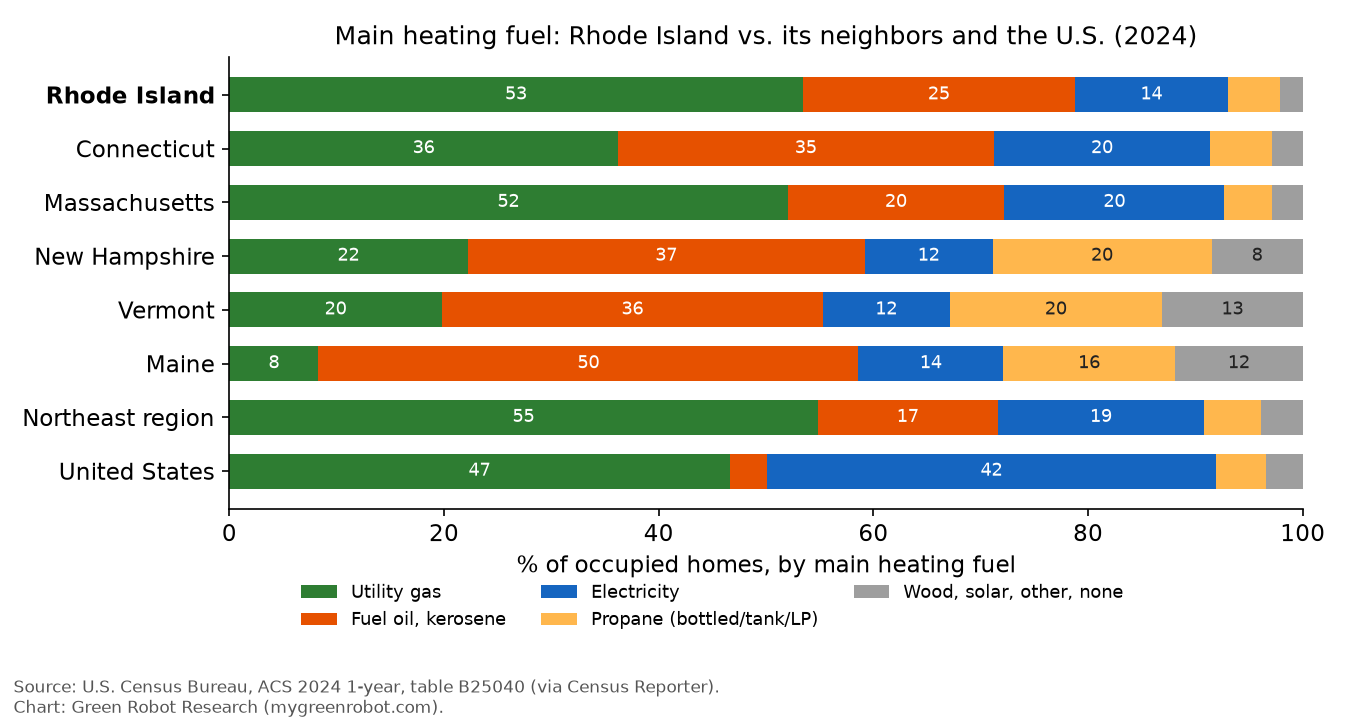
Source: U.S. Census Bureau, ACS 2024 1-year, table B25040. "Northeast region" is the Census region (New England plus New York, New Jersey and Pennsylvania).
Oil use follows the gas mains: about 20% of homes in Providence County, over 40% in Newport and Washington counties.
Main heating fuel by county, 2020–2024 (% of occupied homes)
| County | Utility gas | Oil/kerosene | Electricity | Propane |
|---|---|---|---|---|
| Newport | 33.0 | 43.6 | 13.0 | 7.4 |
| Washington | 30.2 | 40.5 | 14.8 | 10.2 |
| Kent | 50.4 | 31.1 | 11.6 | 3.8 |
| Bristol | 57.1 | 28.1 | 9.2 | 4.5 |
| Providence | 60.9 | 19.9 | 13.4 | 4.0 |
| Rhode Island | 53.0 | 26.6 | 13.0 | 5.0 |
Source: ACS 2020–2024 5-year, B25040, RI counties.
By town, oil heats 78% of homes in Scituate, 71% in Richmond and 68% in Burrillville, but only 8% in Providence and 3% in Central Falls. Fifteen of the 39 cities and towns rely on oil for more than half their homes.
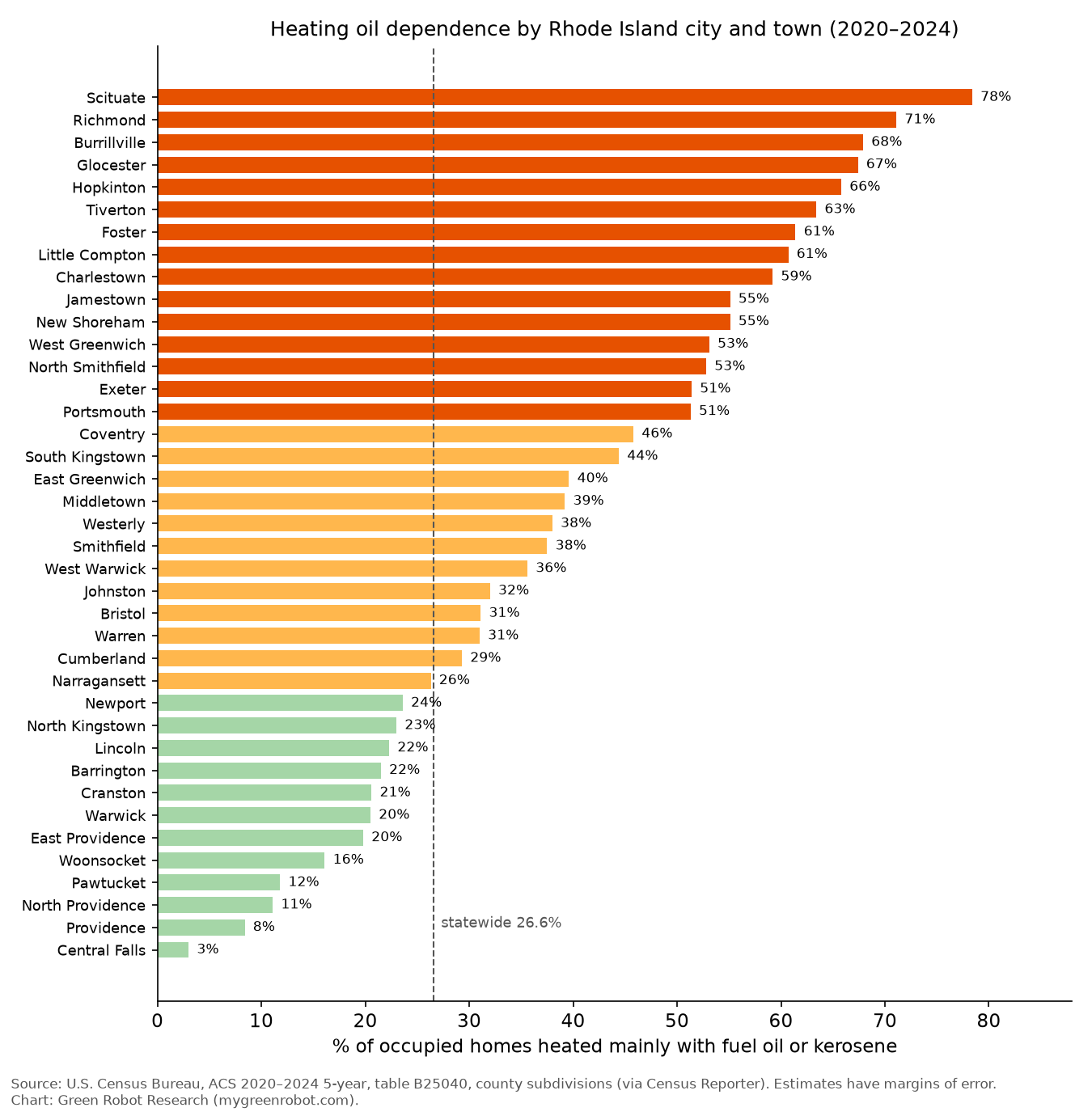
Source: ACS 2020–2024 5-year, B25040, RI county subdivisions. Small towns such as New Shoreham have wide margins of error.
7. What EIA expects for the Northeast this winter
EIA publishes no Rhode Island forecast. Its Northeast numbers assume a winter about 12% milder than last (4,331 heating degree days) and note a strong El Niño, which could push temperatures well away from the forecast:
| Northeast, Oct.–Mar. | Avg. household spending | Change vs. last winter | Avg. price |
|---|---|---|---|
| Natural gas | $879 | −14% | $16.12/Mcf |
| Electricity | $1,637 | −3% | 26.19¢/kWh |
| Propane | $1,687 | −15% | $3.28/gal |
| Heating oil (U.S. figure; no Northeast figure published) | $2,115 | +21% | $5.26/gal |
Source: EIA, Winter Fuels Outlook 2026–27, Oct. 6, 2026. EIA updates it with each Short-Term Energy Outlook; the next is due November 10, 2026.
Rhode Island's current gas, electric and propane prices are all above these Northeast averages.
8. Help paying this winter's bill
- LIHEAP (heating assistance). Open to households at or below 60% of state median income: $43,410 a year for one person, $56,767 for two, $70,124 for three and $83,481 for four (FFY 2027 guidelines). Renters qualify, and you needn't be behind on bills. Grants depend on income, household size and fuel type (RI DHS, income guidelines; RI DHS, LIHEAP). Apply through your local Community Action Program agency or online; DHS call center 1-855-697-4347.
- Weatherization and heating system repair. LIHEAP-eligible households can get free efficiency work through the Weatherization Assistance Program, and owners a heating system repair or replacement through HSRRP (RI DHS, WAP; RI DHS, HSRRP).
- Rhode Island Energy discount rate. 25% off RI Energy bills for households on SNAP, LIHEAP or SSI; 30% for Medicaid, RI Works or public assistance (RI Energy, discount rates).
- Winter shutoff protection. The state moratorium on utility shutoffs runs November 1 to May 1, with protections for LIHEAP households, people 62 and older, and others, subject to conditions (R.I. Gen. Laws § 39-1-63; 810-RICR-10-00-1). Oil and propane deliveries are not covered.
- Private funds. The state's guide lists the Good Neighbor Energy Fund (United Way of RI) and Keep the Heat On for households that are over the limits or have used up other aid (RI DHS, Energy Support RI).
- A possible electric bill credit. The Office of Energy Resources has proposed a RGGI-funded credit for residential electric customers this winter; Rhode Island Energy's hearing notice describes $20.45 a month in January–March 2027. The PUC docket did not show a decision when we checked (Docket 26-28-EL; hearing notice).
9. Incentives to switch or upgrade
- Clean Heat RI pays 60% of a heat pump's cost, up to $11,500, for homes now heated with oil, propane or gas, plus $2,500 for a heat pump water heater (lifetime cap $18,000 per address). It is now RGGI-funded and limited to households below 150% of state median income ($124,950 for one person, $178,500 for four); the home must be weatherized (Clean Heat RI, incentives; OER, Clean Heat RI).
- Rhode Island Energy heat pump rebates (2026): $625 per ton for ducted central heat pumps, $450 for ducted mini-splits, $325 for ductless mini-splits; $1,500 per ton when replacing electric baseboard (requires an assessment and weatherization); up to $75 for a smart thermostat (RI Energy, 2026 heating and cooling rebates). Utility rebates, Clean Heat RI and a $650-per-unit distributor incentive from the New England Heat Pump Accelerator can be combined (RI Energy, 2026 ASHP handout).
- Insulation: after a no-cost assessment, RI Energy offers 50–100% off insulation (up to $10,000), no-cost air sealing and a possible 0% loan (RI Energy, Home Energy Assessment).
- The federal tax credit is gone. The 30% Energy Efficient Home Improvement Credit (up to $2,000 a year for heat pumps) applied only to improvements made through December 31, 2025 (IRS).
10. Free ways to cut the bill

- Book the free Home Energy Assessment (one- to four-unit homes): 888-633-7947, or 401-351-1800 for Discount Rate customers. It unlocks the insulation offers above (RI Energy).
- Turn the thermostat down 7–10°F for 8 hours a day (while asleep or out). The U.S. Department of Energy says this can save up to 10% a year on heating and cooling. Heat pump owners should do this only with a thermostat designed for heat pumps (DOE, Energy Saver guide).
- Seal air leaks around plumbing and wiring holes, outlets, attic openings and fireplace dampers. DOE puts the savings from sealing uncontrolled leaks at 10–20% of heating and cooling bills (DOE, Energy Saver guide).
- Oil and propane customers: compare and check your own price. Dealers' prices vary around EIA's average. Compare any fixed or capped contract with the current weekly price (EIA, Rhode Island prices), and order before the tank is nearly empty.
- Apply for LIHEAP early; it covers delivered fuels too.
- If you have a heat pump and a boiler, run the heat pump first. At current prices, each unit of heat costs less from a heat pump than from oil or propane (section 5).
- Check whether you qualify for the 25% or 30% discount rate if anyone in the home gets SNAP, LIHEAP, SSI or Medicaid (RI Energy).
Data limitations
- Gas rates are proposed, not final. The November 1 gas figures come from Rhode Island Energy's filing; the PUC can change them.
- Oil and propane prices change weekly and exclude taxes. EIA averages across dealers; your price may differ. Bill figures assume a constant price all winter.
- No Rhode Island bill forecast exists. EIA forecasts only by region, and gives no Northeast figure for heating oil. Our Rhode Island bill figures are our own arithmetic from the stated prices and quantities.
- Efficiencies and heat pump COPs are our assumptions. Real performance depends on equipment age, installation and outdoor temperature. Heat pump COP drops in deep cold.
- The winter gas estimate applies the company's forecast of the seasonal share of residential heating use and the bill table's average per-therm cost. Rates are higher in peak months, so the real winter bill is probably slightly higher.
- Oil share is uncertain. The Census (2024) says 25.4% of homes; the state energy office says "about a third". We couldn't reconcile them. The town figures are 5-year averages with margins of error.
- EIA's 2025 Rhode Island annual gas price wasn't published, so that chart ends in 2024.
How we calculated
- Cost per delivered MMBtu = price ÷ (heat content × efficiency). Heat contents from EIA: 138,500 Btu per gallon of heating oil, 91,452 per gallon of propane, 100,000 per therm, 3,412 per kWh. Efficiencies assumed: oil 85%, propane 90%, gas 95%, resistance 100%, heat pump seasonal COP 2.5 and 3.0.
- Gas price per therm (~$2.063): the slope of Rhode Island Energy's proposed bill table between 512 and 1,060 therms ($2,378.81 − $1,248.25) ÷ 548 therms. The table implies about $192 a year in fixed charges.
- Marginal electric price (~33.6¢/kWh): (17.029 + 6.853 + 1.947 + 5.275 + 1.199)¢ × 1.04 gross earnings tax.
- Winter gas bill (~$1,290): 845 therms × 69.5% (Nov–Mar share of forecast residential heating throughput) × $2.063, plus five months of fixed charges.
- Fuel mix: ACS table B25040 shares of occupied housing units; the RI oil margin of error (±5,090 homes) is from the same table.
- Our code and data:
make_charts_heat.py, with raw and derived data indata/heat/.
Our full process for sourcing and correcting data is on the Methodology page.
About Green Robot Research. Green Robot Research is the research section of Green Robot (mygreenrobot.com), led by founder Rafael Escobar. It publishes Rhode Island household-cost data built only from public sources, each one linked, and explains how it checks and corrects data on its Methodology page.
Sources
- U.S. EIA, Weekly heating oil and propane prices, Rhode Island (release of Oct. 21, 2026): https://www.eia.gov/dnav/pet/PET_PRI_WFR_DCUS_SRI_W.htm
- U.S. EIA, weekly No. 2 heating oil residential prices by state/region: https://www.eia.gov/dnav/pet/pet_pri_wfr_a_EPD2F_prs_dpgal_w.htm ; weekly propane residential prices: https://www.eia.gov/dnav/pet/pet_pri_wfr_a_EPLLPA_prs_dpgal_w.htm
- U.S. EIA, Heating Oil and Propane Update: https://www.eia.gov/petroleum/heatingoilpropane/
- U.S. EIA, Winter Fuels Outlook 2026–27 (Oct. 6, 2026): https://www.eia.gov/outlooks/steo/report/perspectives/2026/10-winterfuels/article.php
- U.S. EIA, Natural gas prices, residential, by state (annual): https://www.eia.gov/dnav/ng/ng_pri_sum_a_EPG0_PRS_DMcf_a.htm
- U.S. EIA, British thermal units (heat content): https://www.eia.gov/energyexplained/units-and-calculators/british-thermal-units.php
- RI PUC, Docket 26-23-NG (2026 GCR and DAC): https://ripuc.ri.gov/Docket-26-23-NG ; revised schedules (Sept. 23, 2026): https://ripuc.ri.gov/sites/g/files/xkgbur841/files/2026-09/26-23-NG%20-%20RI%20Energy%20Revised%20Schedules%20to%20GCR%20and%20Supplemental%20DAC%20Filing%20-%20PUC%2009-23-2026.pdf ; GCR filing Book 1: https://ripuc.ri.gov/sites/g/files/xkgbur841/files/2026-09/Book%201%20-%20Redacted-26-23-NG%20-%20GCR.pdf
- RI PUC, winter rates public comment hearing notice (Sept. 2026): https://ripuc.ri.gov/sites/g/files/xkgbur841/files/2026-09/Winter%20Rates%20Public%20Comment%20Hearing%20Notice%20v2%20-%20Sept%202026.pdf
- RI PUC, Docket 25-22-NG (interim GCR filing and withdrawal): https://ripuc.ri.gov/Docket-25-22-NG
- RI PUC, Docket 26-28-EL (RGGI bill credits): https://ripuc.ri.gov/Docket-26-28-EL
- RI PUC, Docket 25-45-GE Heat Pump Settlement: https://ripuc.ri.gov/sites/g/files/xkgbur841/files/2026-06/25-45-GE-Heat%20Pump%20Settlement%20-%20Added%20Signatures%20%28PUC%206-9-2026%29.pdf
- Rhode Island Energy, LRS rates table, Oct. 2026–Mar. 2027: https://www.rienergy.com/site/-/media/rie-jss-app/home/ways-to-save/rates-and-shopping/last-resort-service/LRS-Rates-Table_Ind-Oct26-Mar27.pdf
- Rhode Island Energy, residential service rates: https://www.rienergy.com/site/ways-to-save/rates-and-shopping/service-rates/residential-service-rates
- Rhode Island Energy, discount rates: https://www.rienergy.com/site/ways-to-save/assistance-programs/discount-rates
- Rhode Island Energy, Home Energy Assessment: https://www.rienergy.com/site/ways-to-save/ways-to-save-energy/home-energy-assessment
- Rhode Island Energy, 2026 residential electric heating and cooling rebates: https://rienergy.com/site/-/media/rie-jss-app/home/ways-to-save/rebates-and-savings-programs/heating-and-cooling/Residential_Electric_Heating_Cooling_Rebates_2026.pdf ; 2026 ASHP handout: https://www.rienergy.com/site/-/media/rie-jss-app/home/ways-to-save/rebates-and-savings-programs/heating-and-cooling/RI-Home-Show-Handout-2026-ASHP.pdf
- Clean Heat Rhode Island, incentives and eligibility: https://cleanheatri.com/resources/incentives/
- RI Office of Energy Resources, Clean Heat RI: https://energy.ri.gov/heating-cooling/clean-heat-ri ; heating oil: https://energy.ri.gov/heating-cooling/home-heating-options/heating-oil
- U.S. Census Bureau, American Community Survey 2024 1-year and 2020–2024 5-year, table B25040, via Census Reporter: https://censusreporter.org/data/table/?table=B25040&geo_ids=04000US44
- RI DHS, FFY 2027 low income guidelines: https://dhs.ri.gov/programs-and-services/energy-assistance-programs-heating/ffy-2026-low-income-guidelines ; LIHEAP: https://dhs.ri.gov/programs-and-services/energy-assistance-programs-heating/low-income-home-energy-assistance-program ; WAP: https://dhs.ri.gov/programs-and-services/energy-assistance-programs-heating/weatherization-assistance-program-wap ; HSRRP: https://dhs.ri.gov/programs-and-services/energy-assistance-programs/heating-system-repair-and-replacement-program ; Energy Support RI: https://dhs.ri.gov/programs-and-services/energy-assistance-programs-heating/energy-support-ri
- R.I. Gen. Laws § 39-1-63: https://webserver.rilegislature.gov/statutes/TITLE39/39-1/39-1-63.htm ; 810-RICR-10-00-1: https://rules.sos.ri.gov/Regulations/part/810-10-00-1
- IRS, Energy Efficient Home Improvement Credit: https://www.irs.gov/credits-deductions/energy-efficient-home-improvement-credit
- U.S. DOE, Energy Saver guide (2022): https://www.energy.gov/sites/default/files/2022-08/energy-saver-guide-2022.pdf
Charts by Green Robot Research from the public data above. Free to reuse with credit: "Chart: Green Robot Research (mygreenrobot.com)". Chart code: make_charts_heat.py.