
Blog
Rhode Island's winter electric rate just jumped 21%. Here's what's on your bill, and what you can still control
By Green Robot Research · October 27, 2026
Every number below links to the public source it came from.
If your October electric bill looked heavier than September's, it's not your imagination. On October 1, 2026, Rhode Island Energy's residential Last Resort Service (LRS) supply rate went to 17.029¢ per kWh, up from the summer rate of 11.092¢. For a typical customer using 500 kWh a month, the company's own filing puts the increase at $30.93 a month, or 21.4% (RI PUC, Docket 26-27-EL filing, July 22, 2026).
Last winter the same rate was 14.770¢. This winter's is higher.
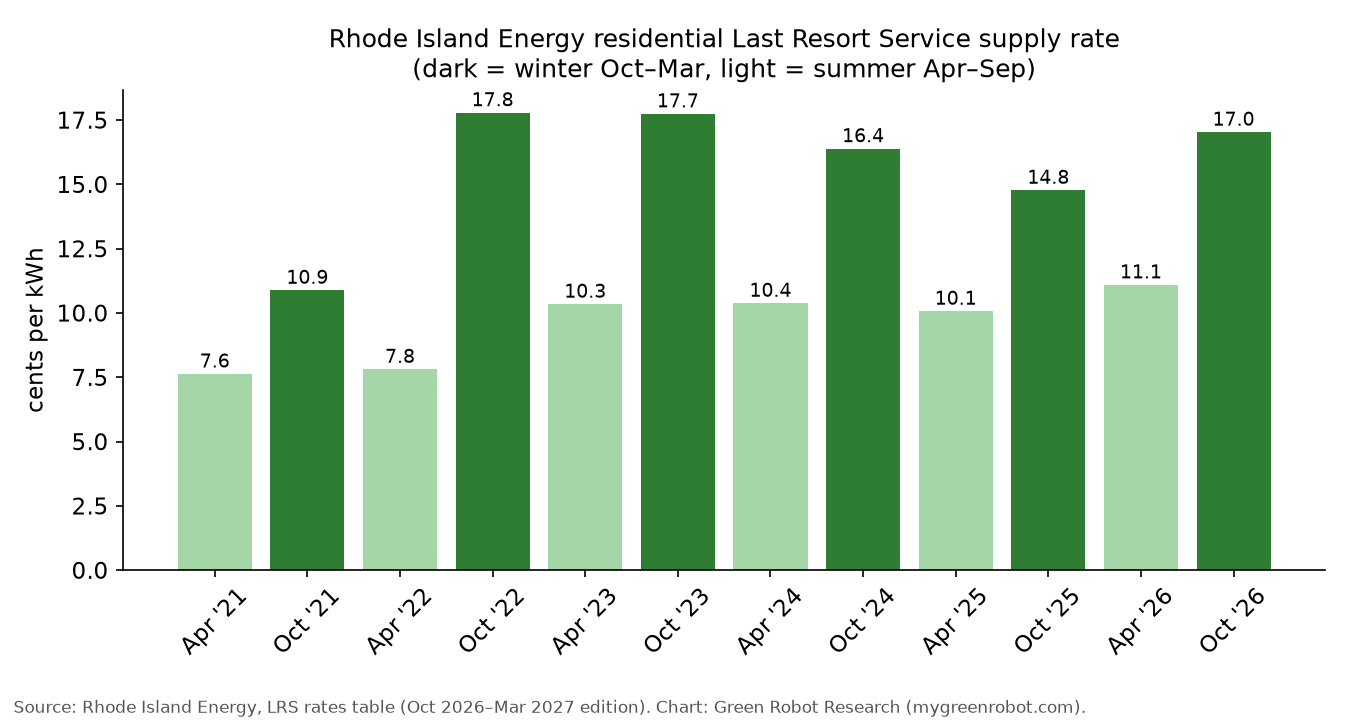
Source: Rhode Island Energy LRS rates table.
The pattern is the same every year: supply is bought twice a year, winter rates (October–March) run higher than summer rates (April–September). Rhode Island Energy says it expects the summer rates filed in January 2027 to come in lower than this winter's (PUC filing). That doesn't help much in January.
Why this winter is higher
In testimony filed with the PUC, Rhode Island Energy points to three cost components (PUC filing, Docket 26-27-EL):
- Grid reliability costs. Ancillary service costs rose as ISO New England, the regional grid operator, rolled out new reliability-focused programs meant to keep power available during periods of system stress.
- Renewable Energy Standard. Rhode Island's renewable energy requirement escalates every year, so suppliers must buy a larger share of renewable energy certificates.
- Natural gas and wholesale power. The company cites upward pressure on natural gas and wholesale power prices, driven by growing LNG export demand, lower European gas inventories and geopolitical uncertainty.
What's actually on a $179.96 bill
The PUC publishes a breakdown of a typical residential bill at 500 kWh. As of October 1, 2026 it totals $179.96 (RI PUC, Electric Bill Components 10-1-26):
| Component | Monthly |
|---|---|
| Supply | $77.13 |
| Distribution | $40.58 |
| Public policy programs | $28.69 |
| Transmission | $26.38 |
| Taxes | $7.20 |
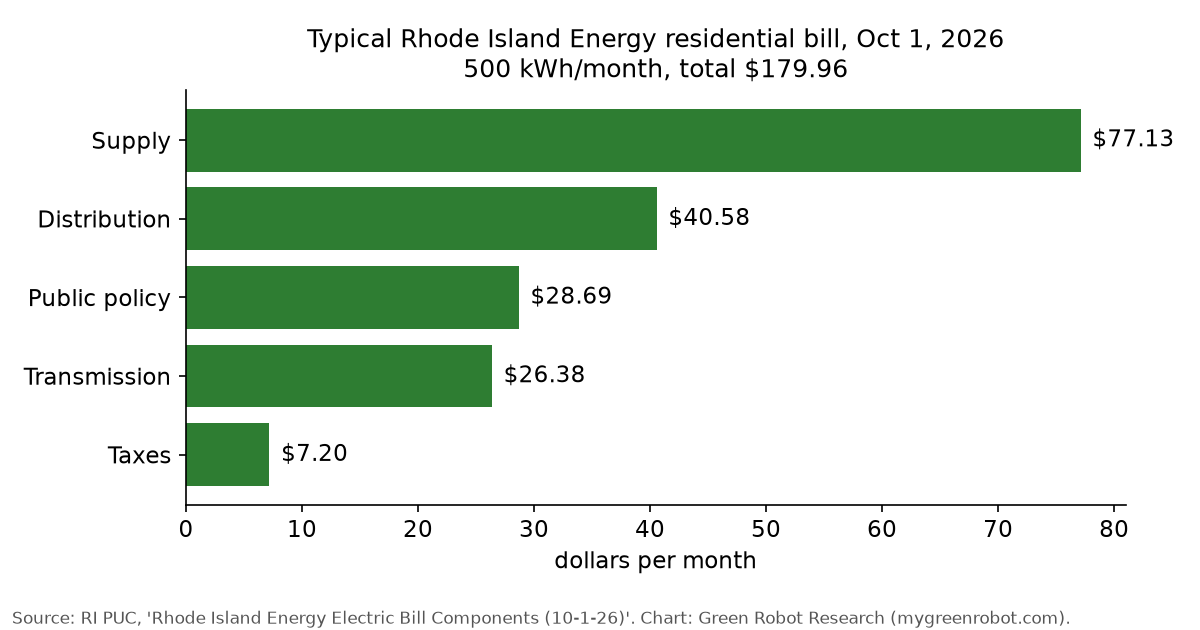
Supply is the biggest piece, and it's the only piece most households can shop for.
How Rhode Island compares
The U.S. Energy Information Administration's latest monthly data (August 2026) puts Rhode Island's average residential price at 28.18¢ per kWh, up from 26.53¢ a year earlier. The New England average was 28.31¢ (EIA Electric Power Monthly, Table 5.6.A).
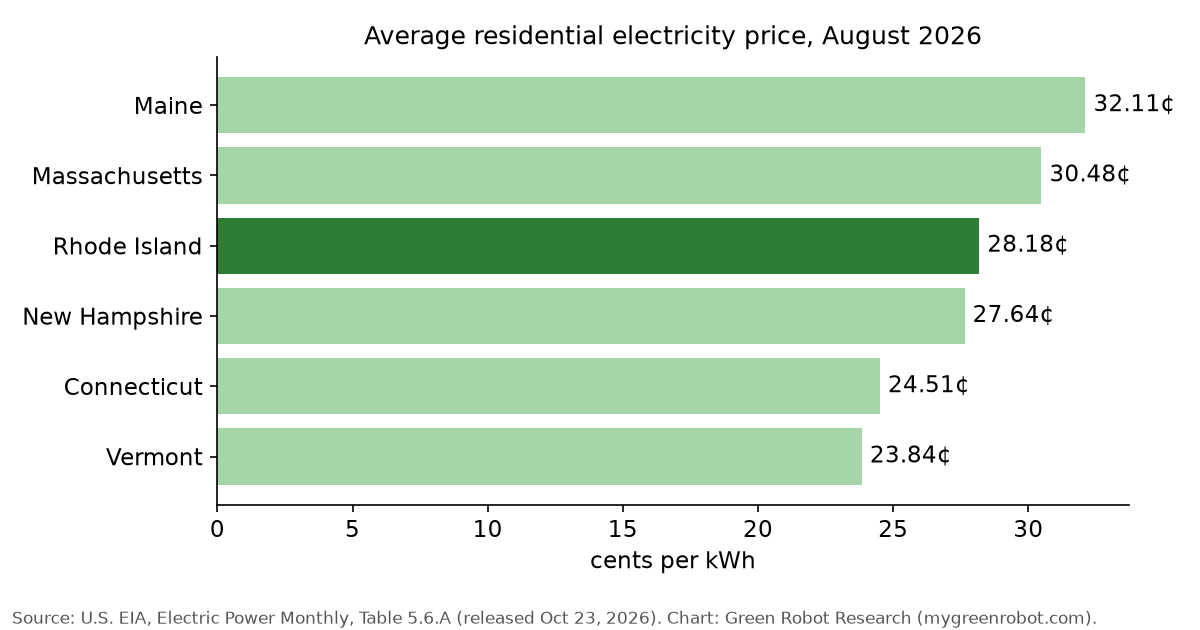
And it's not only electricity. In the Boston area, the nearest metro with its own Bureau of Labor Statistics price index, energy prices were up 21.7% from September 2025 to September 2026, while all prices rose 3.8% (BLS CPI, Boston-Cambridge-Newton, September 2026).
Not everyone pays the same: Rhode Island's three electric utilities
Almost every Rhode Island household gets its power delivered by Rhode Island Energy (legally, The Narragansett Electric Company). Two small public utilities serve the rest: the Block Island Utility District on Block Island, and the Clear River Electric & Water District in the Pascoag area of Burrillville, formerly the Pascoag Utility District.
Their prices are very different. Using the monthly sales and revenue each utility reports to the U.S. Energy Information Administration, the average residential price from January through August 2026 was (EIA, Form EIA-861M):
| Utility | Residential customers (Jul 2026) | Avg. price, Jan–Aug 2026 | January 2026 | July 2026 |
|---|---|---|---|---|
| Block Island Utility District | 1,645 | 39.16¢/kWh | 29.20¢ | 49.74¢ |
| Rhode Island Energy | 336,924* | 28.59¢/kWh | 30.07¢ | 27.65¢ |
| Clear River Electric & Water District | 4,404 | 18.40¢/kWh | 17.76¢ | 18.40¢ |
| Rhode Island, all residential | 29.05¢/kWh | 30.14¢ | 28.29¢ |
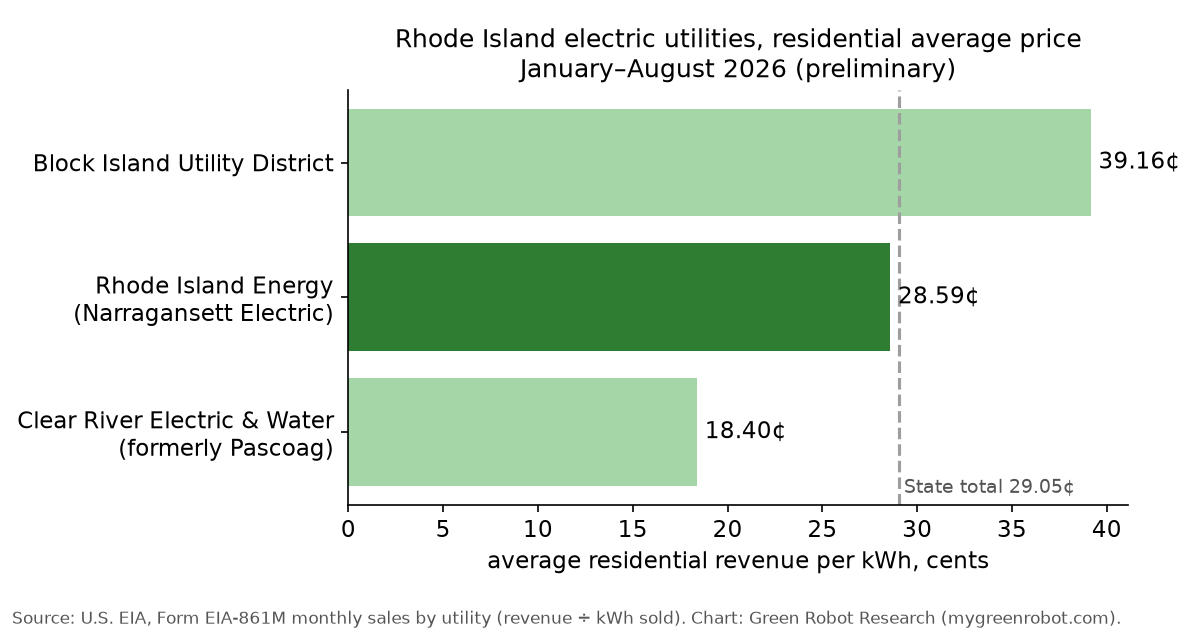
These are averages (revenue divided by kilowatt-hours sold), not tariff rates, and EIA marks the 2026 figures preliminary. *EIA's Rhode Island Energy line counts customers who buy their supply from the utility; households on a competitive supplier or a town aggregation plan are reported in a separate statewide line.
- Block Island prices climb in summer because the district's distribution charge is seasonal: 28.50¢/kWh in July and August, 14.25¢ in May, June, September and October, and 8.95¢ in other months, plus a $10 monthly customer charge (Block Island Utility District tariffs). Its 2026 power supply rate is 9.49¢ and its transmission rate 8.36¢, effective January 1, 2026 (RI PUC, Docket 25-56-EL compliance tariff).
- Clear River Electric & Water charges a supply rate of 7.1499¢/kWh and a transmission rate of 5.3239¢/kWh from January 1, 2026, set in PUC Order 25693 (RI PUC, Docket 25-48-EL).
What about town by town? We looked for a public dataset of household electricity prices by city or town in Rhode Island and didn't find one; EIA reports by utility, not by town. The closest thing is the supply price each town's aggregation program sets, covered below.
Ten years of electricity prices vs. pay and inflation
Between 2015 and 2025, Rhode Island's average residential electricity price rose 53%, from 19.29¢ to 29.48¢ per kWh. Over the same years, average pay in Rhode Island rose 40% and consumer prices rose 33–35% (EIA; BLS CPI-U Northeast; BLS CPI-U Boston; BLS QCEW).
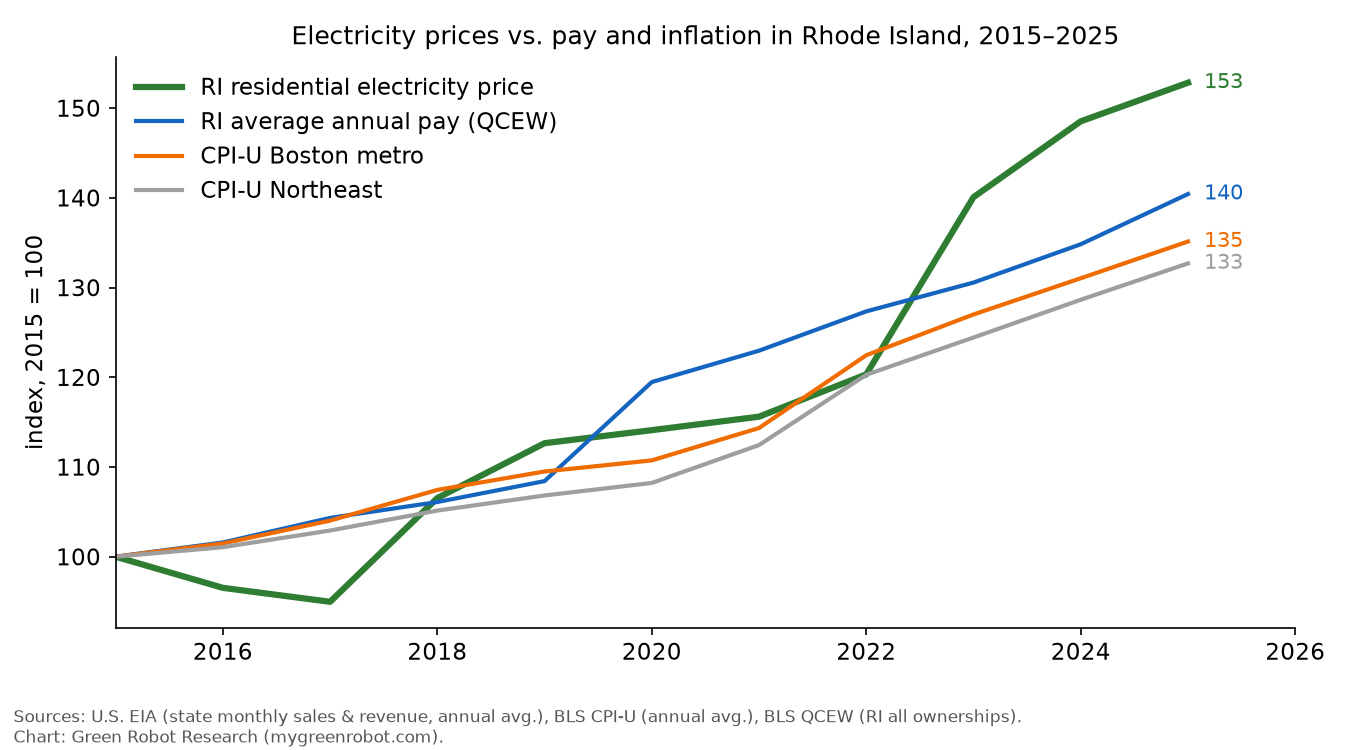
| Year | RI electricity, ¢/kWh | RI avg. annual pay | CPI-U Northeast | CPI-U Boston |
|---|---|---|---|---|
| 2015 | 19.29 | $50,651 | 252.185 | 256.715 |
| 2017 | 18.32 | $52,840 | 259.538 | 267.033 |
| 2019 | 21.73 | $54,918 | 269.392 | 281.082 |
| 2021 | 22.30 | $62,280 | 283.557 | 293.521 |
| 2023 | 27.02 | $66,126 | 313.786 | 326.016 |
| 2025 | 29.48 | $71,123 | 334.618 | 346.889 |
| 2015→2025 | +53% | +40% | +33% | +35% |
Most of the gap opened in 2023, when the average price jumped 16% in a single year (23.21¢ to 27.02¢). Until 2022, electricity had roughly tracked inflation.
How we built it: the electricity price is EIA's annual residential revenue divided by kWh sold in Rhode Island (it includes delivery and supply). Pay is the BLS Quarterly Census of Employment and Wages annual average for all Rhode Island jobs; the 2020 jump partly reflects lower-paid jobs lost during the pandemic, not raises. CPI figures are annual averages. Each series is indexed to 2015 = 100.
What this winter could cost: November through March
For a Rhode Island Energy customer on Last Resort Service, here is an estimate for the five coldest months:
| Month | Typical use | Estimated bill |
|---|---|---|
| November 2026 | 455 kWh | $164.82 |
| December 2026 | 603 kWh | $214.62 |
| January 2027 | 633 kWh | $224.72 |
| February 2027 | 581 kWh | $207.22 |
| March 2027 | 524 kWh | $188.04 |
| Total | 2,796 kWh | ≈ $999 |
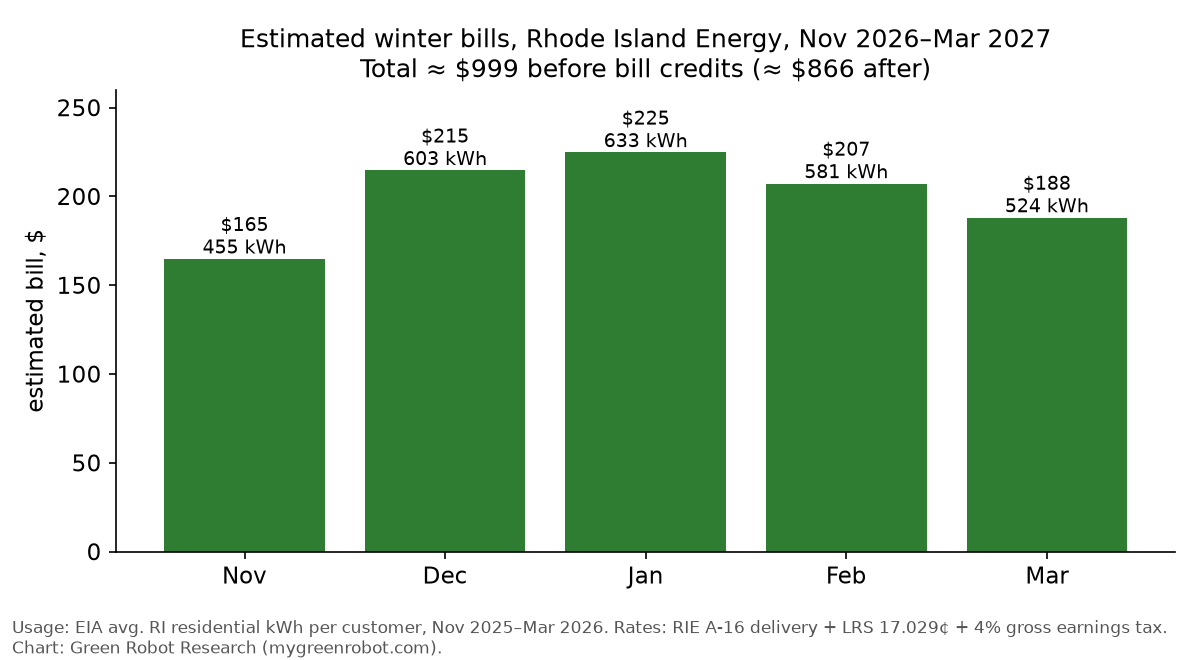
Assumptions
- Usage: the average Rhode Island residential customer's monthly use for the same months a year earlier, November 2025 to March 2026, from EIA's state data (EIA-861M). A house heated with electricity will use far more; one heated with gas or oil and using little power will use less.
- Rates: Rhode Island Energy's current basic residential (A-16) delivery charges: a $7.47 monthly customer charge, distribution 6.853¢, renewable energy distribution 1.947¢, transmission 5.275¢, energy efficiency 1.199¢ per kWh, a $3.00 RE Growth charge and a $0.78 LIHEAP charge (Rhode Island Energy, residential service rates). We add the 17.029¢ LRS supply rate and Rhode Island's 4% gross earnings tax. At 500 kWh this method reproduces the PUC's $179.96 typical bill exactly (PUC bill components).
- We assume the rates above stay the same through March. The 17.029¢ supply rate is fixed through March 2027 (LRS rates table), but delivery charges can change if the PUC approves new ones.
- No discount. The estimate excludes heating fuel (gas, oil, propane) and assumes no low-income discount.
- Before bill credits. The table shows charges before two bill credits, both approved:
- $14.51 a month on every active Rhode Island Energy electric account, on bills from October 2026 through September 2027. This is the "hold harmless" credit tied to PPL's purchase of the utility; the tariff took effect October 1, 2026 (RIPUC No. 2304).
- $20.45 a month on residential (A-16 and A-60) bills in January, February and March 2027, paid from $28 million in RGGI auction proceeds. The PUC approved it on September 24, 2026, according to the Governor's office (Governor's office; RI Energy tariff advice, Docket 26-28-EL).
- With both credits, the five-month estimate falls from about $999 to about $866: $72.55 from the hold harmless credit (5 × $14.51) and $61.35 from the RGGI credit (3 × $20.45), or $133.90 in all. Credits go by billing month, so the exact months they land on depend on your billing cycle.
For a flat 500 kWh a month, the five months come to $899.80 (5 × $179.96), or about $766 after the two bill credits. At last winter's 14.770¢ supply rate, the same 2,796 kWh would have cost about $66 less. With the 25% A-60 low-income discount, the estimate falls to about $750; with the 30% discount, about $700 (see below).
Shopping for supply: what's on offer right now
Supply is the one part of a Rhode Island Energy bill you can shop for. Delivery charges are the same whoever supplies your power. The state's comparison site, EmpowerRI, run by the Division of Public Utilities and Carriers (DPUC), lists supplier offers next to the utility's rate (EmpowerRI). On October 27, 2026 (2:37 p.m. ET) it showed these residential offers:
| Supplier | Term | Price | Notes from the listing |
|---|---|---|---|
| Think Energy | 5 months | 11.8¢ | |
| Major Energy | 12 months | 14.99¢ | No monthly fee, no early termination fee |
| Major Energy | 24 months | 14.99¢ | No monthly fee, no early termination fee |
| Archer Energy | 20 months | 15.319¢ | $50 early termination fee |
| Archer Energy | 12 months | 15.999¢ | $50 early termination fee |
| Direct Energy | 13 months | 16.29¢ | New customers only |
| Direct Energy | 12 months | 16.69¢ | New customers only |
| Rhode Island Energy LRS (default) | Oct 2026–Mar 2027 | 17.029¢ | |
| Think Energy | 12 months | 17.1¢ | 100% renewable; $100 gift card promotion |
Town aggregation programs set their own supply price for everyone enrolled in their town. For November 2026 to April 2027 meter reads, the standard residential price in Providence, Newport and Narragansett is 16.929¢, 0.1¢ below LRS (Providence Community Electricity; Newport Community Electricity; Narragansett Community Choice Electricity). Last summer it went the other way: the standard price in those programs was 13.519¢, while LRS was 11.092¢.
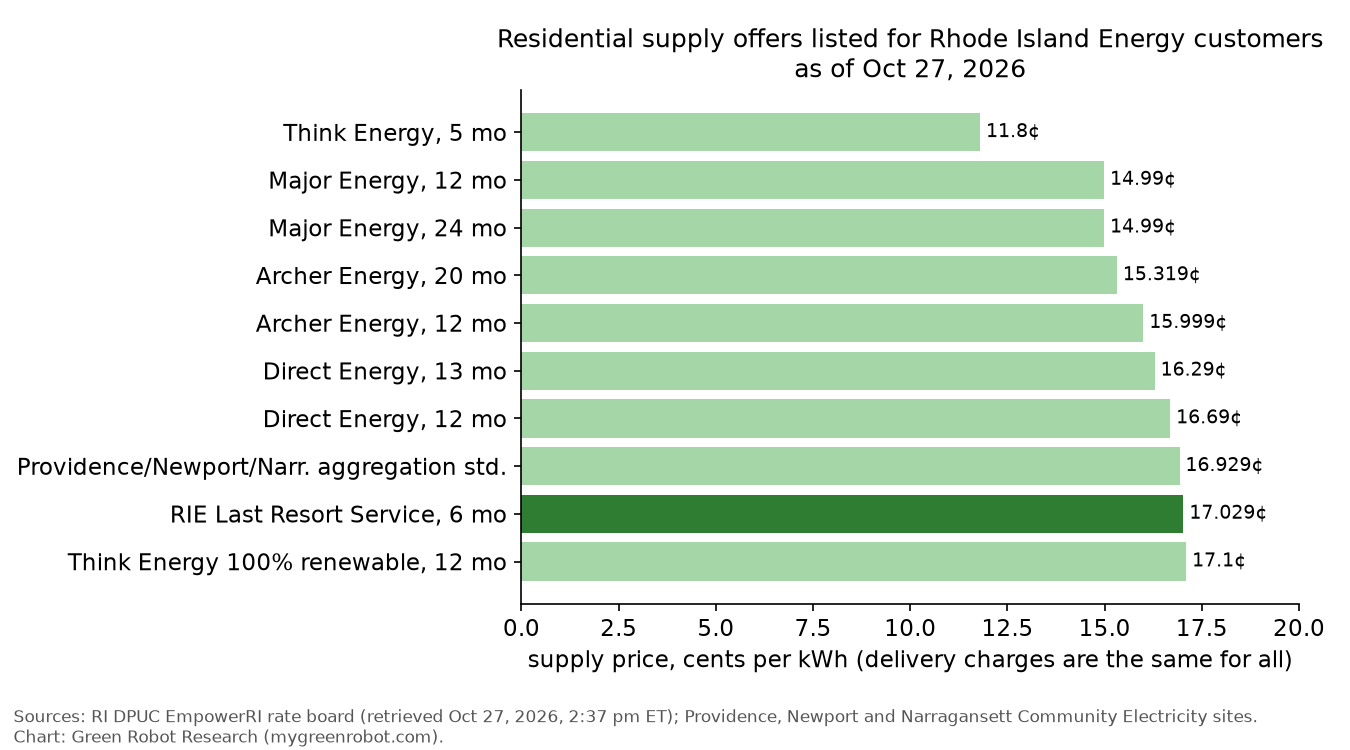
Green Robot Research has no relationship with any supplier listed. Offers change often; check EmpowerRI for current ones.
How to compare an offer
- Compare the price per kWh with 17.029¢ for the months you'll actually be on it. A 12- or 24-month price that beats the winter rate may not beat next summer's LRS rate. Summer LRS rates have been 7.6¢ to 11.1¢ since 2021 (LRS rates table).
- Check whether the rate is fixed or variable, and when it ends. Suppliers must tell you the rate, whether it's fixed or variable, the term and expiration date, and whether the contract renews (R.I. Gen. Laws § 39-26.7-5).
- Look for fees. For residential customers, an early termination fee can't exceed $50 or twice your estimated average monthly energy bill, whichever is less (815-RICR-30-05-2).
- Know your exits. You have three business days to cancel a new supplier contract with no penalty. Rhode Island Energy must move you back to its default service by the next billing cycle after you ask (815-RICR-30-05-2; § 39-26.7-5).
The risks
- Variable rates can rise. A supplier can't charge you 25% more than your original contract price or its last notified rate without giving 15 days' written notice first. Variable-rate customers without a new contract since August 2020 must be notified at least once a year of the rate they're paying and the current default rate.
- No automatic renewals, but watch the end date. Since August 1, 2019, suppliers can't automatically renew a residential contract; a change from fixed to variable or to a different fixed rate needs a new contract (§ 39-26.7-5).
- Short terms and promotions. A short low price or a gift card is only worth it if you know what you'll pay afterward.
If you're struggling to pay: help that exists
Heating assistance (LIHEAP). The federal Low Income Home Energy Assistance Program is run in Rhode Island by the Department of Human Services through local Community Action Agencies. For the 2026–27 season, a household qualifies with income at or below 60% of state median income: $43,410 a year for one person, $56,767 for two, $70,124 for three, $83,481 for four (RI DHS, income guidelines). Renters and owners both qualify. You don't need to be on public assistance or behind on your bill. Applications open October 1. New applicants apply through their local Community Action Agency; DHS's call center is 1-855-697-4347 (RI DHS, LIHEAP).
Discount rate (A-60). Rhode Island Energy's low-income rate takes 25% off the total bill for customers eligible for LIHEAP, enrolled in SNAP or receiving SSI, and 30% for customers on Medicaid, RI Works or General Public Assistance. The account must be in your name, for your primary home (Rhode Island Energy, A-60 tariff, effective Sept 1, 2026). To enroll, send the company a DHS benefits decision notice dated within the last 12 months through its secure upload portal, or call 1-855-743-1101 (Rhode Island Energy, discount rates).
Past-due balances. LIHEAP recipients who owe at least $300 that is more than 60 days past due can also apply for the Arrearage Management Program. Step payment plans are available too, including some with no down payment, and customers with disabilities may qualify for individualized plans (Rhode Island Energy, customer rights insert, March 2026).
Winter shutoff protection. State law sets a winter moratorium on shutoffs from November 1 to May 1 (R.I. Gen. Laws § 39-1-63). During that period, the PUC's rules protect households that receive LIHEAP, include someone 62 or older, are unemployed, have a seriously ill or disabled member, depend on life-support equipment, or include a child under 24 months with financial hardship. Most other residential customers can't be shut off during the moratorium unless they owe more than $500 (if electricity is the main heat source) or more than $200 (if not) (810-RICR-10-00-1). Each protection has conditions, such as medical certification, so confirm with Rhode Island Energy or the DPUC before relying on it.
Four things you can still control (all free)
- Check whether you're even on Last Resort Service. About 73% of Rhode Island Energy's residential consumption is on LRS. You're on it if you haven't picked a competitive supplier and your town doesn't run an aggregation plan (PUC filing).
- Know your town's aggregation plan. The filing lists municipal aggregation plans in Narragansett, Newport, Portsmouth, South Kingstown, Providence, Barrington, Central Falls and North Kingstown, with PUC-approved plans in Bristol, Middletown and Westerly (PUC filing). Compare your town's rate with 17.029¢.
- Compare suppliers with the state's tool. Use EmpowerRI and the checklist above before you sign anything.
- Book the free home energy audit. Rhode Island Energy says residential customers can sign up for a free home energy audit (PUC filing).
What to watch next
Rhode Island Energy will file its next residential supply rates in January 2027, for service starting April 1, 2027 (PUC filing). Until then, the 17.029¢ rate applies to Last Resort Service customers through March 2027 (Rhode Island Energy LRS rates table). The EIA's monthly state data, published with roughly a two-month lag, is the simplest way to track whether Rhode Island's all-in average price keeps climbing (EIA Electric Power Monthly).
About Green Robot Research. Green Robot Research is the research section of Green Robot (mygreenrobot.com), led by founder Rafael Escobar. It publishes Rhode Island household-cost data built only from public sources, each one linked, and explains how it checks and corrects data on its Methodology page.
Sources
- RI PUC, Docket 26-27-EL, Rhode Island Energy LRS winter rates filing (July 22, 2026): https://ripuc.ri.gov/sites/g/files/xkgbur841/files/2026-07/26-27-EL%20-%20LRS%202026%20Winter%20Rates%20%28R%29%28PUC%207-22-26%29.pdf
- RI PUC, Rhode Island Energy Electric Bill Components (Oct 1, 2026): https://ripuc.ri.gov/sites/g/files/xkgbur841/files/2026-10/Rhode%20Island%20Energy%20Electric%20Bill%20Components%20%2810-1-26%29.pdf
- Rhode Island Energy, RIPUC No. 2304, Hold Harmless Implementation Agreement Miscellaneous Bill Credits (eff. Oct 1, 2026): https://www.rienergy.com/site/-/media/rie-jss-app/home/ways-to-save/rates-and-shopping/service-rates/residential-rates/tariff-provisions/tariff-provisions/Tariff-No-2304--Hold-Harmless-Credits--Eff.pdf
- RI PUC, Docket 26-28-EL, Rhode Island Energy tariff advice for RGGI bill credits (Aug 13, 2026): https://ripuc.ri.gov/sites/g/files/xkgbur841/files/2026-08/Docket%2026-28-EL%20-%202026%20RGGI%20Tariff%20Advice%20-%2008-13-2026.pdf
- Office of the Governor, "PUC Approves Governor McKee's $28 Million in Winter Electric Bill Relief" (Sept 24, 2026): https://governor.ri.gov/press-releases/puc-approves-governor-mckees-28-million-winter-electric-bill-relief
- Rhode Island Energy, LRS rates table (Oct 2026–Mar 2027): https://www.rienergy.com/site/-/media/rie-jss-app/home/ways-to-save/rates-and-shopping/last-resort-service/LRS-Rates-Table_Ind-Oct26-Mar27.pdf
- U.S. EIA, Electric Power Monthly, Table 5.6.A (Aug 2026 data, released Oct 23, 2026): https://www.eia.gov/electricity/monthly/epm_table_grapher.php?t=epmt_5_6_a
- U.S. BLS, CPI Boston-Cambridge-Newton, September 2026: https://www.bls.gov/regions/northeast/news-release/consumerpriceindex_boston.htm
- U.S. EIA, Form EIA-861M monthly sales and revenue, by utility and by state: https://www.eia.gov/electricity/data/eia861m/
- Block Island Utility District, tariffs: https://blockislandpowercompany.com/tarrifs/
- RI PUC, Docket 25-56-EL, Block Island Utility District compliance tariff (eff. Jan 1, 2026): https://ripuc.ri.gov/sites/g/files/xkgbur841/files/2026-01/BIUD%2025-56-EL%20Compliance%20Tariff.pdf
- RI PUC, Docket 25-48-EL, Order 25693, Clear River Electric & Water District: https://ripuc.ri.gov/sites/g/files/xkgbur841/files/2026-05/CREW%2025-48-EL_Ord25693_Final.pdf
- U.S. BLS, CPI-U Northeast (CUUR0100SA0): https://data.bls.gov/timeseries/CUUR0100SA0
- U.S. BLS, CPI-U Boston-Cambridge-Newton (CUURS11ASA0): https://data.bls.gov/timeseries/CUURS11ASA0
- U.S. BLS, Quarterly Census of Employment and Wages, Rhode Island annual averages 2015–2025: https://www.bls.gov/cew/
- Rhode Island Energy, residential service rates (A-16): https://www.rienergy.com/site/ways-to-save/rates-and-shopping/service-rates/residential-service-rates
- RI DPUC, EmpowerRI supplier rate board (retrieved Oct 27, 2026): https://www.ri.gov/app/dpuc/empowerri
- Providence Community Electricity, products & pricing: https://electricity.providenceri.gov/choice/
- Newport Community Electricity: https://newportcommunityelectricity.com/
- Narragansett Community Choice Electricity: https://narragansettcommunitychoiceelectricity.com/
- R.I. Gen. Laws § 39-26.7-5, Nonregulated Power Producer Consumer Bill of Rights: https://webserver.rilegislature.gov/statutes/TITLE39/39-26.7/39-26.7-5.htm
- 815-RICR-30-05-2, Nonregulated Power Producer Consumer Bill of Rights (DPUC rule): https://rules.sos.ri.gov/regulations/Part/815-30-05-2
- RI DHS, LIHEAP: https://dhs.ri.gov/programs-and-services/energy-assistance-programs-heating/low-income-home-energy-assistance-program
- RI DHS, LIHEAP income guidelines: https://dhs.ri.gov/programs-and-services/energy-assistance-programs-heating/ffy-2026-low-income-guidelines
- Rhode Island Energy, A-60 low-income tariff No. 2283 (eff. Sept 1, 2026): https://rienergy.com/site/-/media/rie-jss-app/home/ways-to-save/rates-and-shopping/service-rates/residential-rates/tariff-provisions/tariff-provisions/Tariff-No-2283--Electric-A60-Service-TarifSept2026.pdf
- Rhode Island Energy, discount rates: https://www.rienergy.com/site/ways-to-save/assistance-programs/discount-rates
- Rhode Island Energy, customer rights bill insert (March 2026): https://www.rienergy.com/site/-/media/rie-jss-app/home/more/frequent-questions/about-your-bill/bill-inserts/RIE4425-RI-Bi-annual-Insert---March-2026.pdf
- R.I. Gen. Laws § 39-1-63, utility termination moratorium: https://webserver.rilegislature.gov/statutes/TITLE39/39-1/39-1-63.htm
- 810-RICR-10-00-1, PUC termination rules: https://rules.sos.ri.gov/Regulations/part/810-10-00-1
Charts made by Green Robot Research from the public data above. Free to reuse with credit.