
Blog
How Many Yards of Mulch Do You Actually Need? The 3-Inch Rule for Rhode Island Beds
Every spring across Rhode Island, homeowners make the same costly mistake in garden centers: they load 25 plastic bags of mulch into an SUV, haul them home, spread them out, and realize halfway through their front planting beds that they barely covered a third of their yard. Or worse, they guess on bulk delivery and end up with a mountain of mulch blocking half their driveway for weeks.
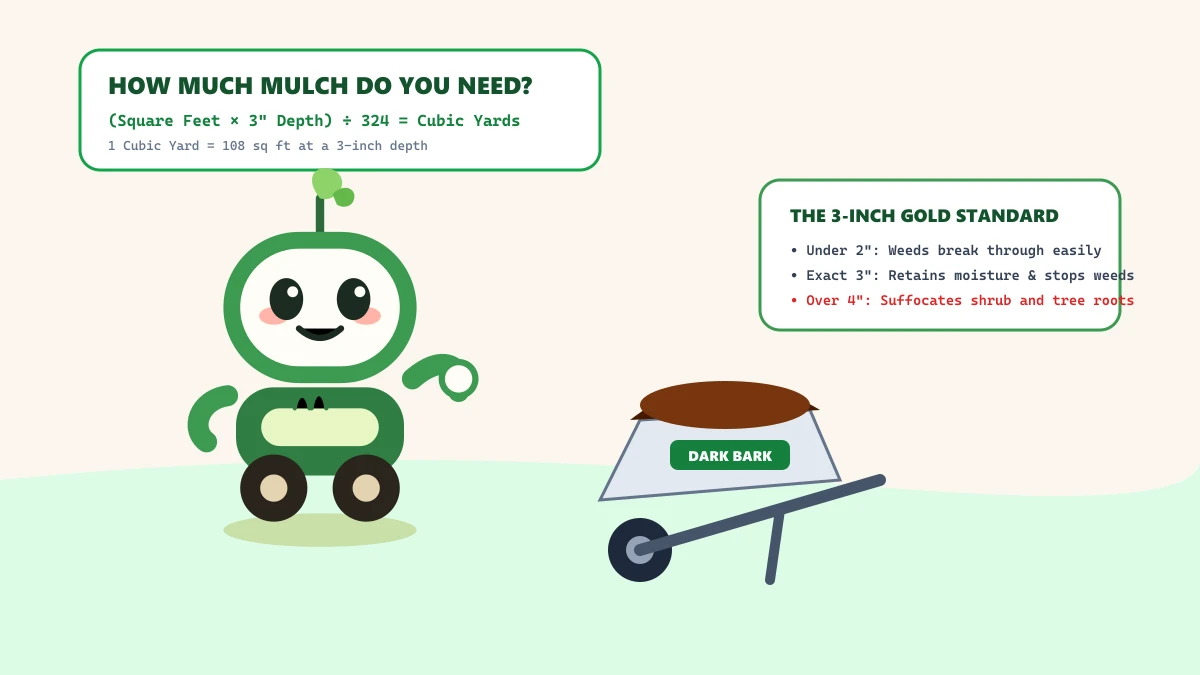
Mulch is measured in cubic yards (27 cubic feet). Calculating the exact amount your Rhode Island property requires is straightforward once you know the 3-inch depth rule.
The Simple Formula for Calculating Cubic Yards
To determine how much mulch you need at the agronomically recommended 3-inch depth:
- The Formula:
(Total Square Feet of Garden Beds × 3) ÷ 324 = Cubic Yards Needed - Rule of Thumb: Every 108 square feet of planting bed requires exactly 1 cubic yard of mulch at a 3-inch thickness.
Quick Reference Chart (3-Inch Finished Depth)
| Planting Bed Area | Square Feet | Cubic Yards Needed | Equivalent in 2-cu-ft Store Bags |
|---|---|---|---|
| Small Townhome Front Bed | 100 sq ft | 1.0 yard | 13.5 bags |
| Suburban Walkway & Foundation Beds | 300 sq ft | 2.8 yards (Order 3) | 38 to 41 bags |
| Standard Quarter-Acre Suburban Lot | 500 sq ft | 4.6 yards (Order 5) | 62 to 68 bags |
| Large Landscaped Corner Lot (Cranston/Warwick) | 850 sq ft | 7.8 yards (Order 8) | 105 to 110 bags |
| Multi-Bed Property / Perennial Borders | 1,200 sq ft | 11.1 yards (Order 11–12) | 150 to 160 bags |
The 3-Inch Depth Rule: Why Thickness Matters
The sweet spot for organic mulch in Rhode Island's coastal climate is precisely 3 inches:
- Under 2 Inches: Sunlight still reaches dormant weed seeds in the topsoil. Moisture evaporates quickly during dry July heat spells, forcing you to run sprinkler irrigation constantly.
- Exact 3 Inches: Creates a cool, insulating thermal blanket that suppresses 90% of weed germination, conserves 40% more soil moisture, and naturally decomposes to enrich sandy Rhode Island topsoil. For even stronger weed control, many homeowners pair fresh mulch with a well-timed pre-emergent weed barrier in early spring.
- Over 4 Inches: Suffocates shrub root systems. Water cannot penetrate through a thick, hydrophobic mulch mat, leading to shallow rooting and fungal root rot. Pruning overgrown foundation bushes with a proper bush and hedge trimming service beforehand ensures proper air circulation and bed visibility.
Stop the "Mulch Volcano": Protecting Rhode Island Trees
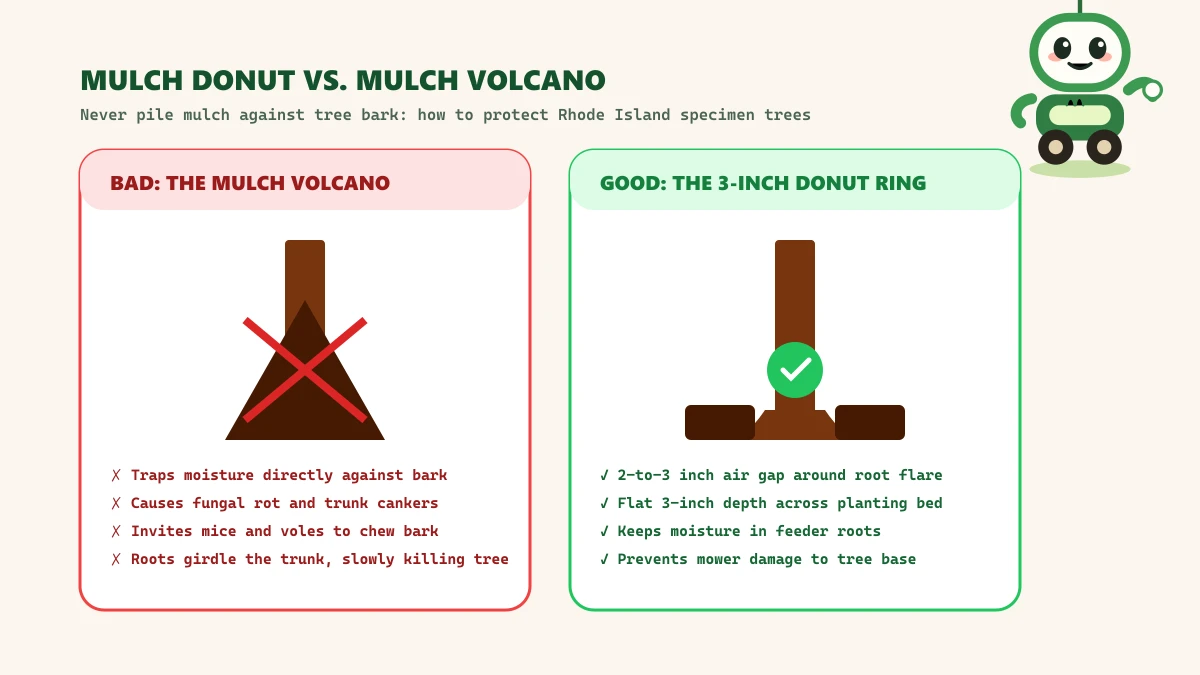
Walk through residential streets in Providence, Warwick, or Newport, and you will see countless trees buried under high cones of bark piled directly against their trunks. Landscape professionals call this a mulch volcano, and it is one of the leading causes of premature shade tree death in New England.
Tree bark requires circulating air and light to stay dry and healthy. When wet, decomposing mulch is piled 6 to 12 inches against the root flare:
- Moisture rots the bark: Decay fungi penetrate into the vascular cambium layer, slowly girdling the tree.
- Rodents nest at the base: Mice and voles burrow into the warm mulch over winter and chew through tender tree bark.
- Roots grow upward: Feeder roots grow into the mulch layer instead of deep soil, wrapping tightly around the trunk in deadly girdling roots.
The Golden Rule: Always leave a 2 to 3-inch bare gap between the tree bark and the mulch ring. Form a flat donut, not a volcano.
Bulk Delivery vs. 2-Cu-Ft Bags: The Real Cost Comparison
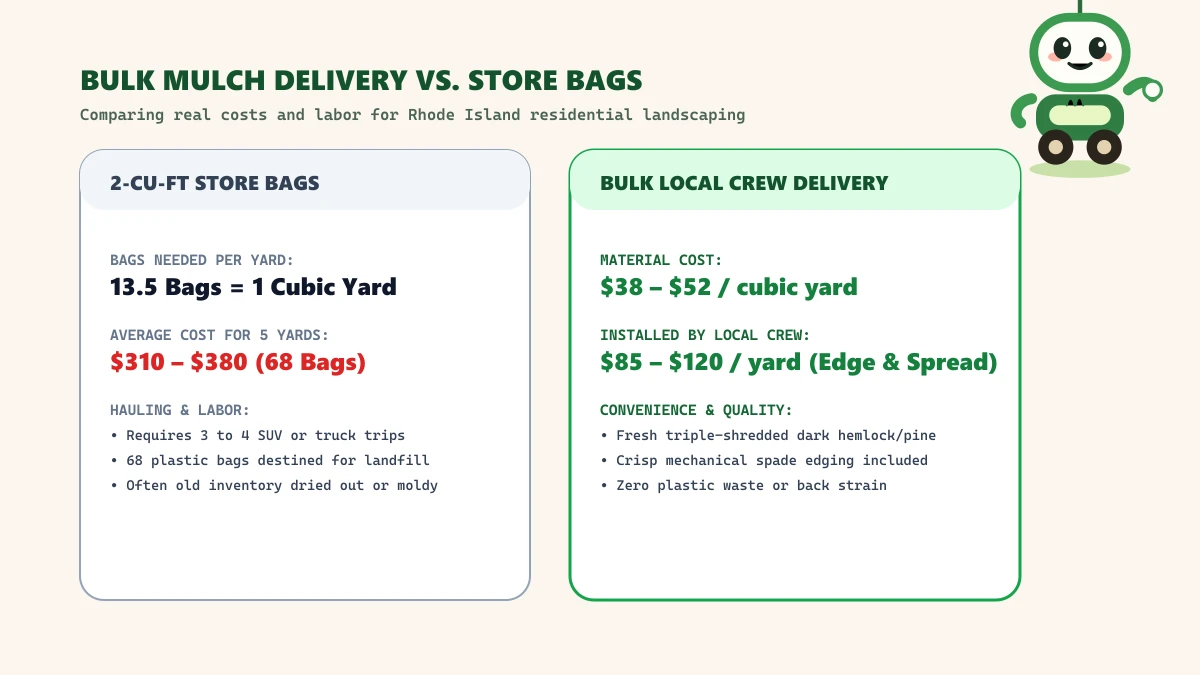
Homeowners often assume buying bagged mulch on sale at a home improvement store is cheaper than ordering bulk delivery from a local Rhode Island landscape supplier or hiring a crew.
When you factor in volume, the economics tell a very different story:
- One cubic yard equals 13.5 two-cubic-foot bags.
- If your property needs 5 cubic yards, you must purchase, load, transport, unload, and slice open 68 heavy plastic bags.
- At an average sale price of $4.50 to $5.50 per bag, 68 bags cost $310 to $375, not including vehicle wear, torn bags leaking in your trunk, and landfill plastic waste.
- By contrast, 5 cubic yards of high-grade, triple-shredded dark hemlock or black bark from a local Rhode Island supplier costs $190 to $260 for bulk delivery.
Hiring a Pro for Professional Mulch Delivery and Installation
Professional crews do not just dump mulch; they cut a clean 2 to 3-inch deep mechanical spade trench (spade-edging) along your lawn perimeter. This crisp vertical edge stops turfgrass rhizomes from creeping into your flower beds and keeps mulch from washing onto sidewalks during heavy nor'easter rains.
Having a vetted local crew deliver, edge, and hand-spread your mulch typically runs $85 to $120 per cubic yard installed (including material). For a standard 5-yard property, having the entire job finished in three hours without back pain is one of the highest-value home improvements of the spring.
Need mulch delivered and installed in Rhode Island?
Skip the heavy lifting and endless store bags. Tell My Green Robot your property details, and we will connect you with verified local landscape crews who will spade-edge your beds and install fresh, clean mulch at fair, transparent rates.