
Blog
How to Stop Crabgrass in Rhode Island: The Forsythia Bloom Timing Rule
Every spring, Rhode Island homeowners waste hundreds of dollars applying crabgrass preventer at the wrong time. Put it down too early in March when ground frosts still hit Cranston and Burrillville, and spring rains wash the chemical barrier away before the first seed wakes up. Wait until mid-May when you actually spot coarse green crabgrass blades in your driveway apron, and pre-emergent herbicide is completely useless because crabgrass seeds have already germinated.
The key to stopping crabgrass in New England comes down to soil temperature, natural phenology, and knowing your local town's microclimate.
The Forsythia Bloom Timing Rule
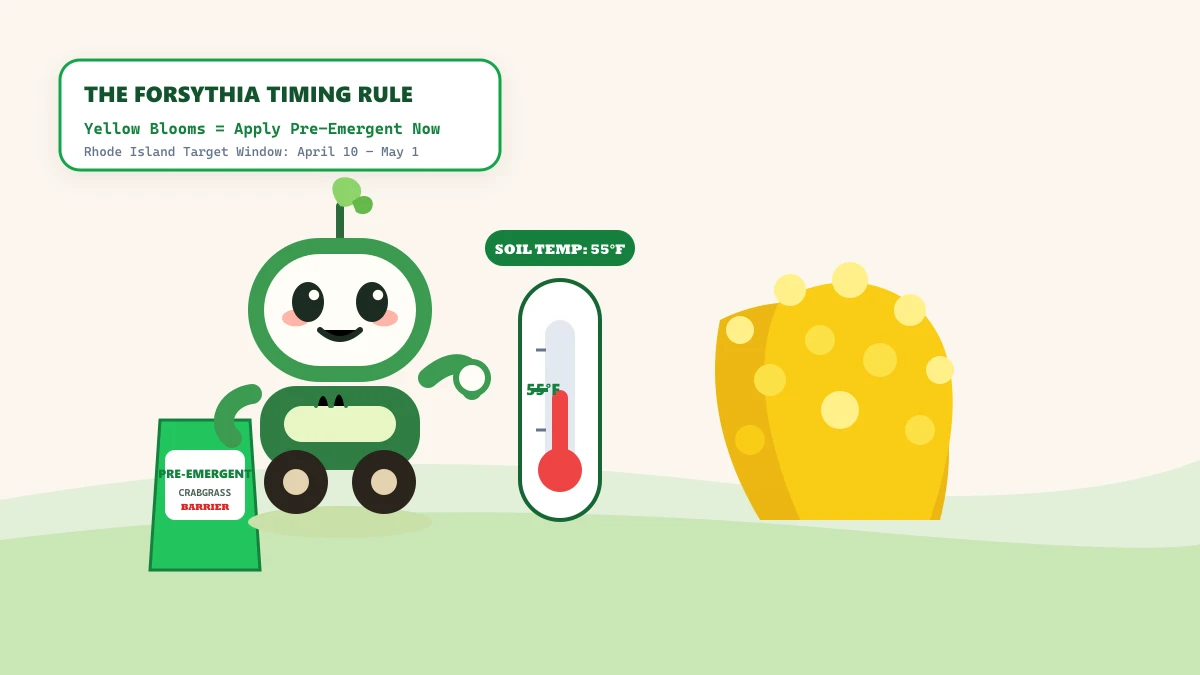
Nature gives Rhode Island yards a clear signal when soil hits the critical temperature window: the blooming of yellow forsythia bushes.
Forsythia shrubs and crabgrass (Digitaria) react to the same thermal accumulation:
- Crabgrass seeds begin germinating when the top inch of soil maintains 55°F for four to five consecutive days.
- Forsythia bushes drop their bright yellow blossoms right as soil hits 55°F to 58°F.
When bright yellow forsythia flowers peak across neighborhoods in Warwick and East Providence, that is your 10-day window to apply pre-emergent herbicide. Once the yellow blossoms drop and green leaves emerge on the shrub, crabgrass germination is already underway.
Inland vs. Coastal Rhode Island Application Windows
Because Narragansett Bay and the cold Atlantic ocean moderate surrounding temperatures, Rhode Island divides into two distinct spring warmup zones:
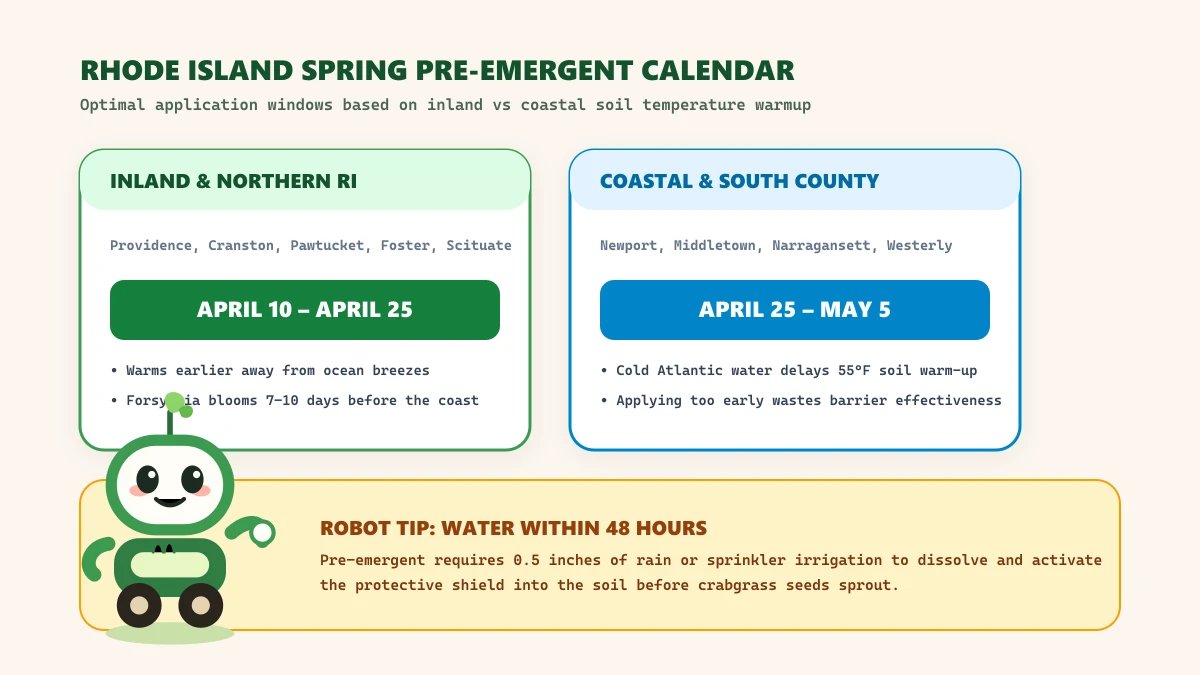
1. Inland & Northern Rhode Island (April 10 – April 25)
- Towns: Providence, Cranston, Pawtucket, Johnston, Cumberland, Smithfield, Foster, Scituate.
- Warmup pattern: Without ocean winds, inland soils absorb radiant solar heat rapidly. Ground temperatures reach 55°F by mid-April.
- Target window: Complete your application between April 10 and April 25.
2. Coastal & South County Rhode Island (April 25 – May 5)
- Towns: Newport, Middletown, Portsmouth, Narragansett, South Kingstown, Jamestown, Westerly.
- Warmup pattern: Surface water temperatures in Rhode Island Sound linger around 42°F in early spring. Strong sea breezes slow coastal soil warming by 7 to 14 days compared to Providence.
- Target window: Applying in early April is premature on Aquidneck Island; aim between April 25 and May 5.
How Pre-Emergent Preventers Work
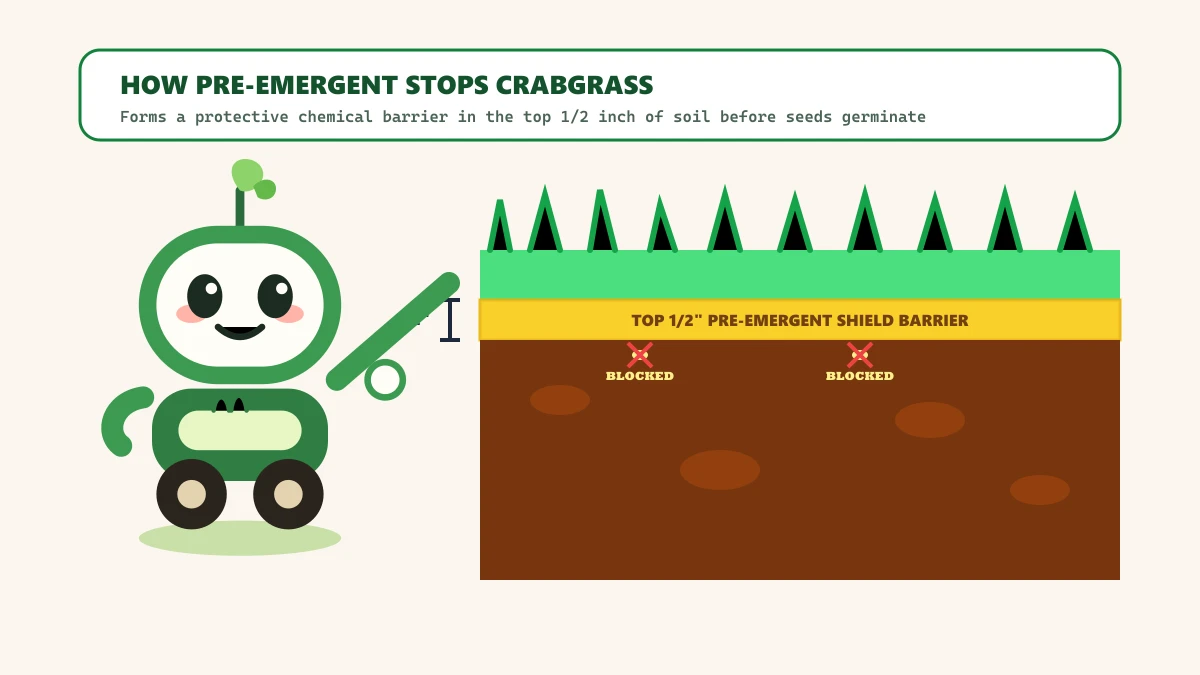
Pre-emergent herbicides do not kill crabgrass seeds. Crabgrass seeds can sit dormant in Rhode Island soil for up to ten years.
Instead, the product dissolves into the top half-inch of turf soil to establish a microscopic chemical barrier. When a crabgrass seed absorbs moisture and sends out its first root radicle (coleoptile), the root contacts the barrier and stops dividing, preventing the weed from establishing.
Critical Application Rules:
- Activate with water within 48 hours: Pre-emergent granules sitting dry on grass blades break down under ultraviolet sunlight. The application requires 0.5 inches of rain or thorough sprinkler watering to wash the barrier into the top half-inch of soil.
- Do not aerate or rake vigorously after application: Power raking or pulling core aeration plugs breaks the chemical shield, opening corridors for crabgrass seeds to sprout.
- Mower blade height matters: Keep your mower deck at 3 to 3.5 inches throughout May and June, as outlined in our first spring lawn cut guide. Taller turf shades the soil surface, reducing ground temperatures by 5°F to 8°F and starving weed seeds of the sunlight needed to break dormancy.
What If You Are Seeding Grass This Spring?
Standard crabgrass preventers like prodiamine, dithiopyr, and pendimethalin cannot tell the difference between crabgrass seeds and desirable turfgrass like Kentucky bluegrass, tall fescue, or perennial ryegrass. If you spread regular pre-emergent alongside new grass seed, none of your lawn seed will germinate.
If you must overseed bare patches in spring:
- Look for pre-emergents containing Siduron (Tupersan) or Mesotrione (Tenacity).
- These selective active ingredients suppress germinating crabgrass while allowing new cool-season lawn seeds to root safely.
- Alternatively, focus spring efforts on crabgrass defense, and save major turf overseeding for late August, which the University of Rhode Island (URI) turfgrass program ranks as the most reliable seeding window (see our Rhode Island frost dates and gardening calendar).
Need spring yard help in Rhode Island?
Local landscape crews know exactly when soil temperatures hit the sweet spot in your neighborhood. Tell the robot your town, and get connected with verified local crews for spring cleanup, pre-emergent application, and seasonal mowing.