
Blog
Lawn Aeration vs Dethatching in Rhode Island: Which Does Your Yard Actually Need?
If your Rhode Island lawn feels thin, puddles during every rainstorm, or turns brown no matter how much fertilizer you throw on it, the issue is almost certainly below the surface. Homeowners often ask whether they need core aeration or dethatching to restore their turf.
While both treatments revive tired lawns, they solve two completely different problems. Choosing the wrong service wastes money and can even tear up healthy turf roots.
Here is how to diagnose what your yard actually needs, how to perform the simple screwdriver and ruler tests, and typical pricing from Rhode Island landscape crews.
Core Aeration: Relieving Compacted Rhode Island Soil with Lawn Aeration
Rhode Island sits on dense glacial till and rocky, compressed soils. In older residential neighborhoods across Cranston, Warwick, and Pawtucket, decades of lawn mowers, parked cars, foot traffic, and winter snowpack compress the top 4 inches of soil into hardpan clay.
When soil compacts, pore space disappears. Water runs off into gutters instead of soaking down to root systems, and grassroots suffocate from a lack of oxygen.
How Core Aeration Works:
A commercial core aerator uses hollow steel tines to punch into the ground, extracting thousands of 2.5-inch-deep soil cores (plugs) across your property.
- The resulting holes allow air, water, and nutrients to penetrate directly to root zones.
- Surrounding soil expands into the open cavities, loosening the entire yard without destroying existing turf.
- The extracted soil plugs dissolve on the surface within two to three weeks through natural rainfall and mowing, returning vital microbes to the turf canopy, especially when combined with a soil-sweetening calcitic lime treatment.
The Screwdriver Compaction Test:
Take a standard 6-inch flathead screwdriver and push it straight down into your lawn when the soil is moist:
- Passes easily with light pressure: Your soil structure is loose and healthy.
- Stops at 1 to 2 inches or requires body weight to drive: Your ground is severely compacted and requires core aeration.
Dethatching: Removing the Choking Organic Mat
Thatch is the layer of living and dead organic matter—stems, stolons, rhizomes, and crown tissue—that accumulates between green grass blades and the soil line. Contrary to popular belief, mulched grass clippings do not cause thatch; clippings are mostly water and break down within days. Thatch builds up when grass produces woody tissue faster than soil microbes can decompose it.
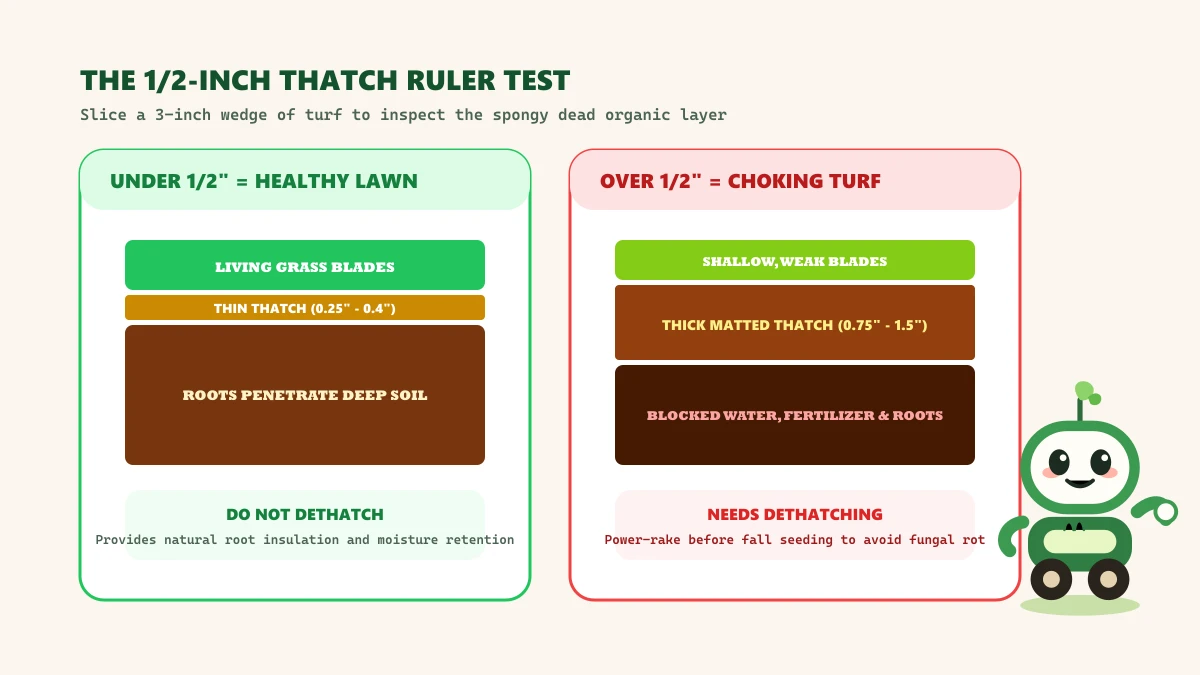
The 1/2-Inch Thatch Ruler Test:
- Use a garden trowel to cut a small 3-inch wedge out of your lawn.
- Look at the brown, fibrous, spongy layer between the green grass blades and the dark mineral soil.
- Measure this layer with a ruler:
Under 0.5 inches: Do not dethatch. A thin thatch layer protects turf crowns from summer heat, retains moisture, and cushions foot traffic. Over 0.5 inches: Dethatch immediately. Thick thatch acts like an impermeable sponge, soaking up rain and fertilizer before it ever reaches the soil. Grass roots start growing sideways inside the thatch mat rather than digging deep into the ground, leaving your lawn vulnerable to summer drought and fungal disease.
Side-by-Side Comparison: Aeration vs. Dethatching
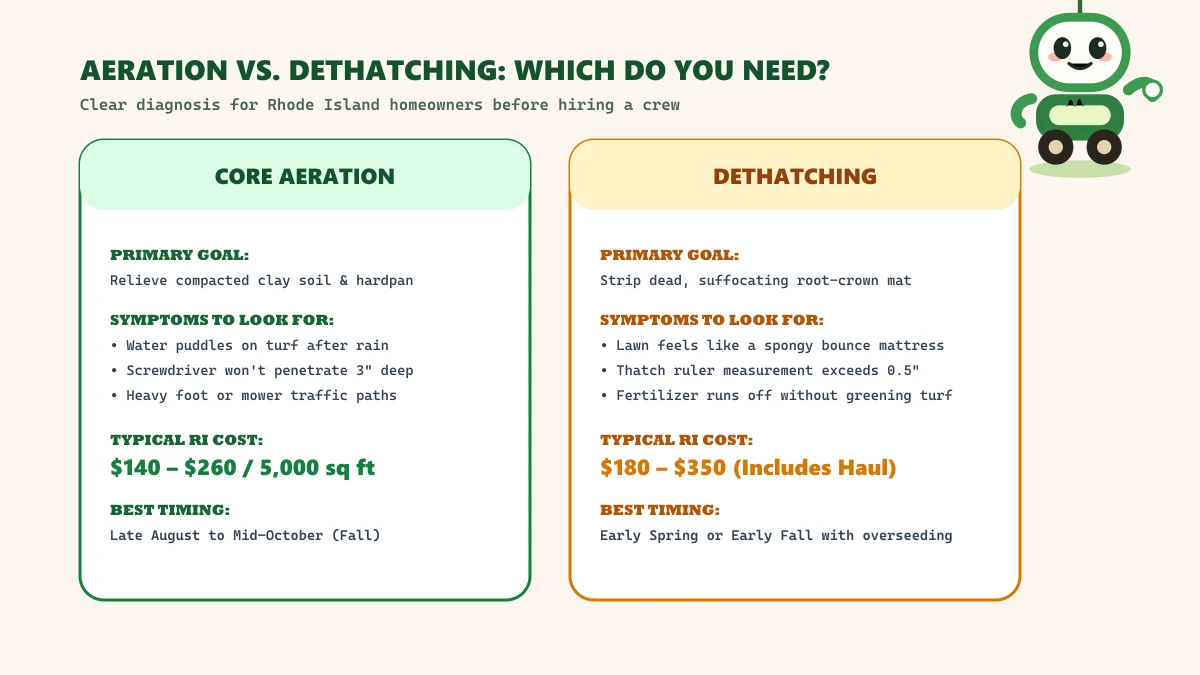
| Feature | Core Aeration | Dethatching (Power Raking) |
|---|---|---|
| Primary Problem Solved | Compacted, rocky clay soil and poor drainage | Thick, suffocating mat of dead organic stems |
| How Turf Feels | Hard as concrete; water puddles on surface | Spongy and bouncy underfoot, like walking on a mattress |
| Best Equipment | Commercial hollow-tine walk-behind or stand-on aerator | Power rake or dethatcher with spring tines / flail blades |
| Root Impact | Strengthens and deepens root systems | Pulls up dead material; may temporarily thin weak grass |
| Ideal Timing in RI | Late August to Mid-October (Fall overseeding window) | Early Spring (April) or Early Autumn alongside overseeding |
| Typical RI Cost (5,000 sq ft) | $140 – $260 | $180 – $350 (Includes heavy raking and haul-away) |
Timing Your Service in Rhode Island
In Rhode Island, early autumn (August 25 to October 15) is the single best window for both services, particularly core aeration.
During autumn, Rhode Island soil remains warm from summer sun while air temperatures cool down. Weeds like crabgrass are dying off, and autumn rainfall reduces watering demands. If you combine core aeration with fall overseeding and starter fertilizer, grass seeds drop straight into the open aeration holes when using high-germination grass seed for Rhode Island, achieving a 90%+ germination rate.
Early spring (April) is an acceptable secondary window for dethatching if your lawn is suffocating, but avoid aggressive core aeration in late spring, as open holes break your protective crabgrass pre-emergent barrier.
Need aeration or dethatching quotes in your town?
Local lawn crews carry heavy-duty commercial aerators and power rakes that get the job done in under an hour. Tell the robot your property size, and compare written quotes from vetted Rhode Island professionals.