

Blog
Rhode Island Lawn Care Schedule: Month-by-Month Turf Calendar
Related pages: lawn care near you, Rhode Island frost dates and gardening calendar, aeration vs dethatching in Rhode Island, and first spring lawn mow.
Rhode Island lawns consist almost entirely of cool-season turfgrasses: Kentucky Bluegrass, Perennial Ryegrass, Fine Fescues, and Turf-Type Tall Fescues. These grasses thrive in spring and autumn, slow down during humid July heat, and go dormant under winter snow cover.
Because Rhode Island’s coastal microclimates differ significantly between coastal Aquidneck Island and the inland hills of Foster and Glocester, following a generic national calendar leads to wasted treatments, burned grass, or crabgrass infestation.
Here is the month-by-month Rhode Island lawn care schedule based on University of Rhode Island (URI) Cooperative Extension agronomy, local soil temperatures, and state environmental regulations.
The Annual Rhode Island Turf Calendar at a Glance
| Month | Primary Lawn Care Action | Soil Temp Benchmark | Key Products / Treatments |
|---|---|---|---|
| March | Yard cleanup, branch clearing, soil testing | Under 45°F | URI soil test kit, rake matted turf |
| April | First seasonal mow, crabgrass pre-emergent | 48°F – 55°F | Pre-emergent herbicide, dolomitic limestone |
| May | Weekly mowing begins, broadleaf weed spot treatment | 55°F – 65°F | Post-emergent herbicide (dandelions/clover) |
| June | Raise mower cutting height (3.0 – 3.5"), grub prevention | 65°F – 70°F | Preventative grub control (chlorantraniliprole) |
| July | Deep watering (1" per week), minimize traffic | 72°F+ | Irrigation audit, no fertilizer |
| August | Late-month core aeration, dethatching, overseeding prep | 68°F – 74°F | Core aerator rental or contractor booking |
| September | Peak overseeding, starter fertilizer, repair bare patches | 62°F – 68°F | RI-adapted cool season seed blend, starter fertilizer |
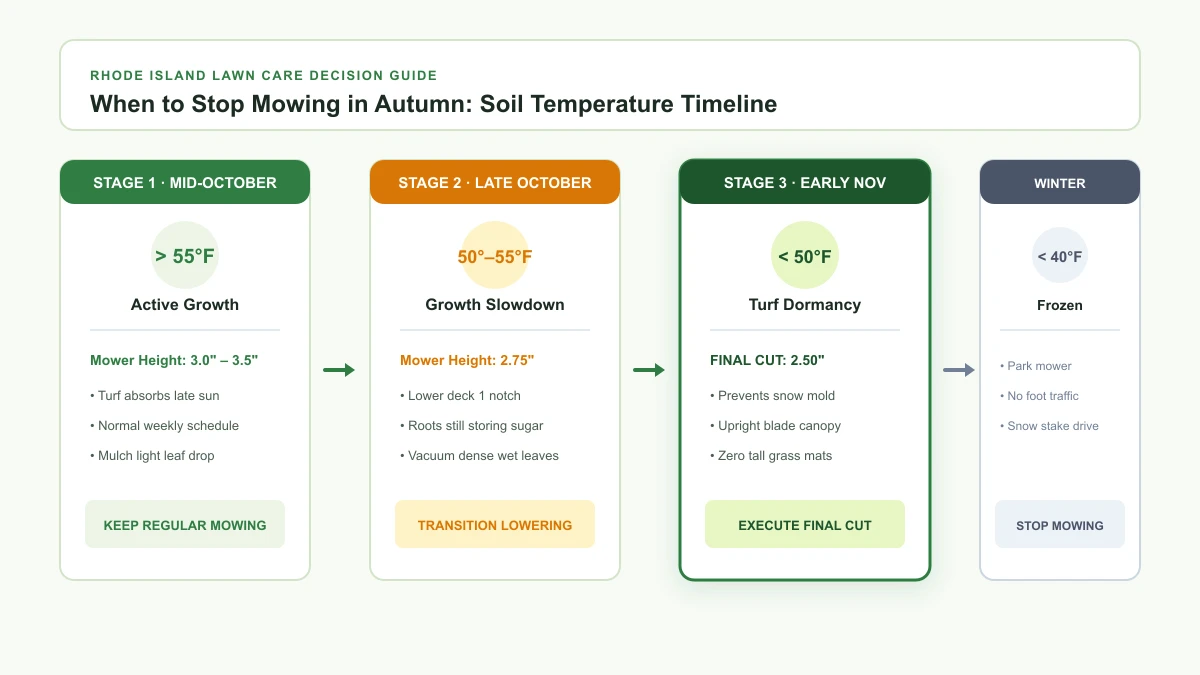
| October | Fall leaf mulching, final fall fertilizer, lower deck | 50°F – 60°F | Slow-release nitrogen fertilizer, leaf blowers |
| November | Final winterizer cut (2.25 – 2.5"), clean mower deck | Under 48°F | Final cut before Nov 15 state fertilizer blackout |
| Dec – Feb | Winter dormancy, avoid walking on frozen turf | Under 32°F | Winter mower storage, blade sharpening |
Month-by-Month Action Plan
March: Cleanup and Soil Testing
- The Goal: Wake up the lawn gently without compacting wet soil.
- Inspect for snow mold: Rake matted patches of grass flattened by heavy winter snowdrifts to allow sunlight and airflow to reach dormant crowns.
- Clear storm debris: Pick up fallen oak and pine limbs, acorns, and windblown branches before they damage mower blades.
- Send a soil sample to URI: The University of Rhode Island provides comprehensive soil testing. Rhode Island soils are naturally acidic (pH 5.2 to 5.8) due to granite bedrock and pine needle accumulation. Turfgrass requires a pH of 6.2 to 6.8 to absorb nutrients. A soil test tells you exactly how many pounds of dolomitic limestone per 1,000 square feet your yard needs.
April: The First Cut & Crabgrass Defense
- Soil Temperature Milestone: 50°F to 55°F.
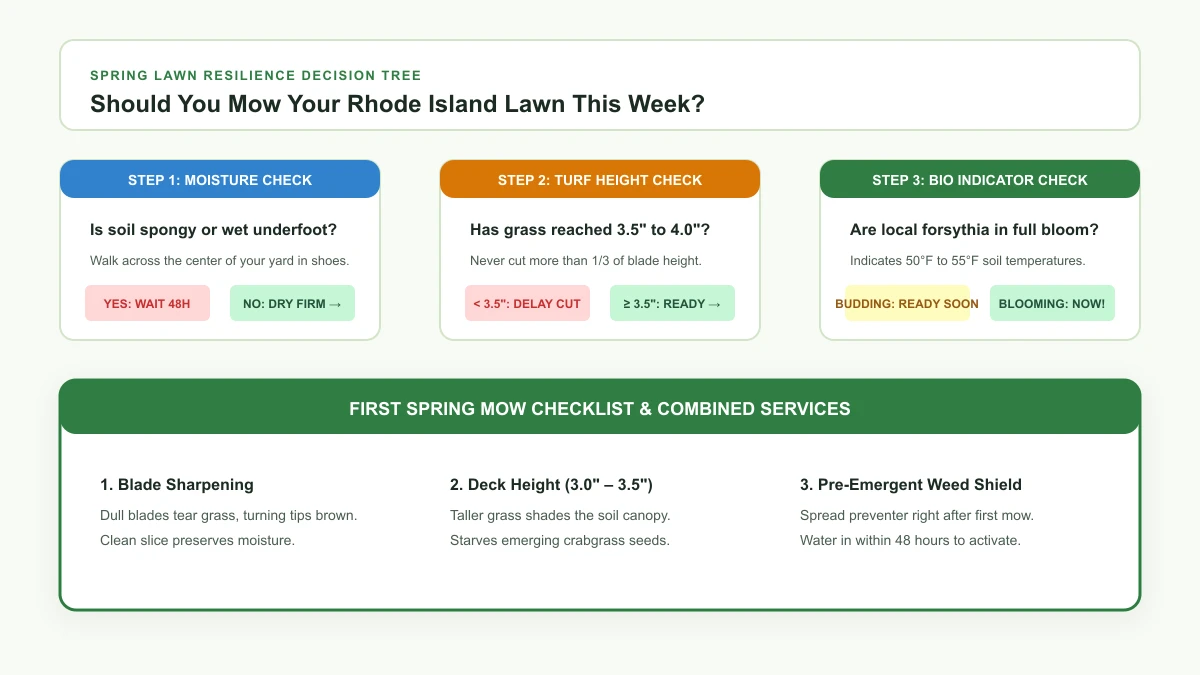
- The First Mow: Cut when grass reaches 3.5 to 4.0 inches, taking off no more than the top 1/3 of the blade. Set mower deck to 2.75 to 3.0 inches.
- Crabgrass Pre-Emergent: The most critical timing decision of spring. Apply pre-emergent when soil temperatures hit 52°F at a 2-inch depth for three consecutive days. In Rhode Island, nature signals this when yellow forsythia bushes are dropping their final blossoms.
- Warning: If you plan to seed bare spots in spring, you cannot use standard pre-emergent (prodiamine or pendimethalin) because it blocks grass seed germination for 12 weeks. Use mesotrione (Tenacity) instead for safe spring seeding.
May: Mowing Velocity & Broadleaf Weeds
- Mowing Frequency: Shift to strict 5 to 7-day weekly mowing. May is peak vegetative growth for cool-season turf.
- Blade Sharpening: Dull mower blades tear grass tips rather than cutting cleanly, leaving yellow-brown frayed edges prone to leaf spot fungus.
- Broadleaf Weed Treatment: Spot-treat visible dandelions, plantain, and clover using a selective liquid post-emergent herbicide on a calm, sunny morning when no rain is forecast for 24 hours.
June: Raising Mower Decks & Preventative Grub Control
- Raise Mower Height: Raise mower decks to 3.25 to 3.5 inches. Taller grass blades shade soil roots, reduce soil water evaporation by up to 35%, and crowd out weed seeds.
- Preventative White Grub Control: Japanese beetles and European chafers lay eggs in Rhode Island turf throughout June and July. Apply preventative grub control (such as Acelepryn / chlorantraniliprole or Merit / imidacloprid) in late June before larvae hatch and chew through root systems.
July: Heat Management & Smart Watering
- Summer Stress Protocol: When air temperatures exceed 85°F, cool-season grasses enter semi-dormancy to conserve carbohydrates.
- Watering Rules: Lawns need 1.0 to 1.5 inches of water per week, delivered in one or two deep morning sessions (5:00 AM to 9:00 AM) rather than daily evening sprinkles. Daily light watering encourages shallow root systems and fungal disease.
- Fertilizer Warning: Never apply quick-release nitrogen fertilizer in July. Forcing new top growth during summer heat burns crowns and invites brown patch disease.
August: The Late-Summer Pivot (Aeration & Overseeding Prep)
- August 1 – 15: Monitor for summer annual weeds and chinch bug damage in sunny coastal yards (Narragansett, Newport, Westerly).
- August 20 – 31 (The Gold Standard Window): Begin fall aeration and overseeding.
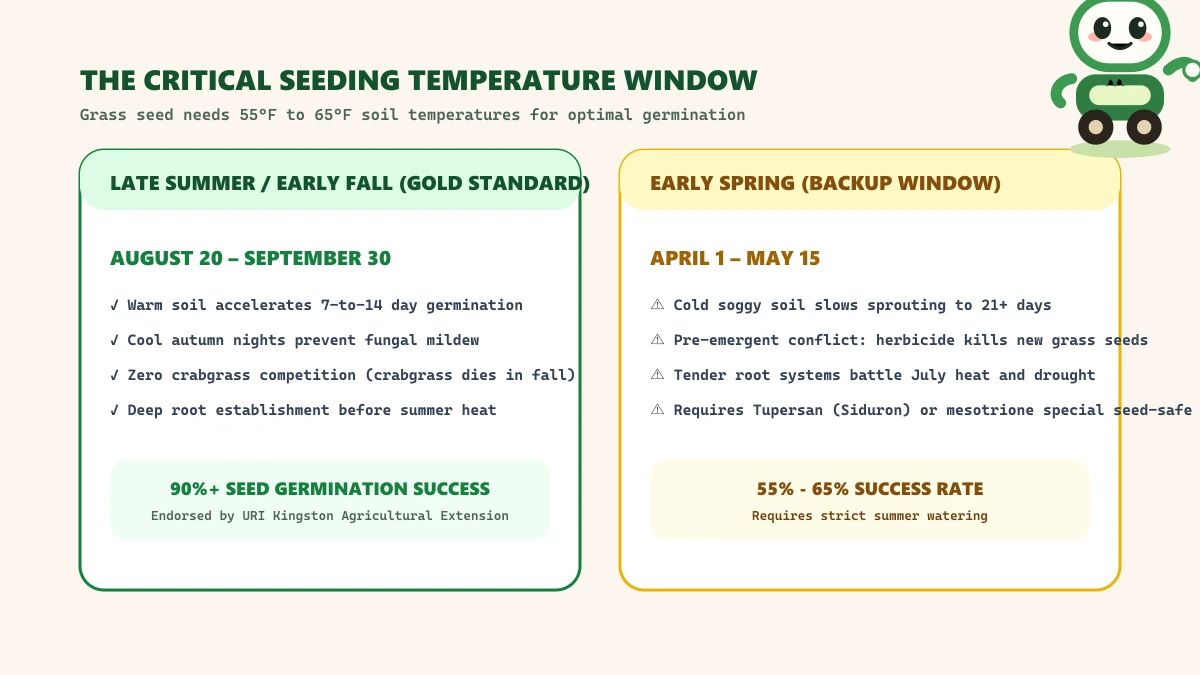
August 20 to September 25 is the single best window of the year to seed a lawn in Rhode Island. Soil temperatures are 68°F to 72°F, triggering rapid germination in 7 to 14 days, while falling nighttime temperatures eliminate the risk of summer fungal die-off.
September: Aeration, Seeding, and Starter Fertilizer
- Core Aeration: Pull 2-to-3-inch soil cores across the lawn to relieve summer soil compaction, puncture thatch layers, and create direct seed-to-soil contact channels.

- Overseed with Quality Cool-Season Blends: Spread 4 to 6 pounds per 1,000 square feet of a certified New England blend: 60% Turf-Type Tall Fescue, 20% Kentucky Bluegrass, and 20% Perennial Ryegrass.
- Starter Fertilizer: Apply a high-phosphorus starter fertilizer to nourish delicate young root systems.
- Keep Seed Moist: Water seeded areas 2 to 3 times daily for 5 to 8 minutes each until seedlings reach 2 inches tall.
October: Leaf Management & Fall Feeding
- Leaf Mulching: Rather than raking every oak leaf into bags, run a mulching mower over dry fallen leaves weekly. Mulched leaf particles decompose quickly, adding natural organic carbon back into Rhode Island's sandy loam soils.
- Fall Root Feeding: Apply a slow-release nitrogen fertilizer in early to mid-October. Grass blades will stop vertical growth as temperatures drop, but root systems continue storing energy until ground freeze.
November: The Final Cut & State Regulatory Blackout
- The Final Cut: Set your mower deck down to 2.25 to 2.5 inches for the final seasonal mow in early to mid-November. Cutting shorter before winter prevents tall grass blades from matting down under heavy snow and developing gray snow mold (Typhula fungus).
- November 15 Legal Fertilizer Blackout: Under Rhode Island DEM regulations, no homeowner or commercial contractor may apply nitrogen or phosphorus fertilizers between November 15 and March 15. Winterized turf cannot absorb nutrients, leading to toxic chemical runoff into Narragansett Bay.
- Equipment Winterization: Drain or stabilize fuel, clean under deck housings, wash away corrosive grass juices, and disconnect batteries for winter storage.
Need Local Help Keeping Your Yard on Schedule?
Maintaining a 12-month lawn schedule requires commercial machinery, precise calibration, and weekend time.
With My Green Robot, you don't have to spend hours calling contractors or comparing confusing estimates. Simply tell the robot your yard size and service needs—from weekly mowing to fall aeration and spring cleanup—and verified local Rhode Island pros compete to deliver clear, written bids with $0 platform markup.
Explore local Rhode Island lawn care prices or chat with the robot to get your property scheduled today!
FAQ
When should I start lawn care in Rhode Island in the spring?
Active lawn care in Rhode Island begins in late March to early April once soil temperatures stabilize above 45°F and the ground dries out enough to support foot traffic without compacting saturated root zones. The first spring mow typically occurs between April 10 and April 25.
When should I apply crabgrass pre-emergent in Rhode Island?
Apply pre-emergent crabgrass preventer when soil temperatures reach 50°F to 55°F at a 2-inch depth for three consecutive days. In Rhode Island, this biological window coincides with peak yellow forsythia blossom drop, usually between April 15 and May 5 along the coast and April 20 to May 10 inland.
When is the best month to aerate and seed grass in Rhode Island?
Late summer to early fall—specifically August 20 to September 25—is the premier window for core aeration, dethatching, and overseeding in Rhode Island. Warm soil (65°F to 72°F) coupled with cooling evening air and autumn rains provides optimal seed germination with zero competition from spring weeds.
What is the Rhode Island legal deadline for applying fertilizer?
Under Rhode Island state law (the Turf Fertilizer Act enforced by RI DEM), no nitrogen or phosphorus fertilizers may be applied to turfgrass between November 15 and March 15. Applying fertilizer during this winter blackout period risks water runoff into Narragansett Bay and local groundwater aquifers.